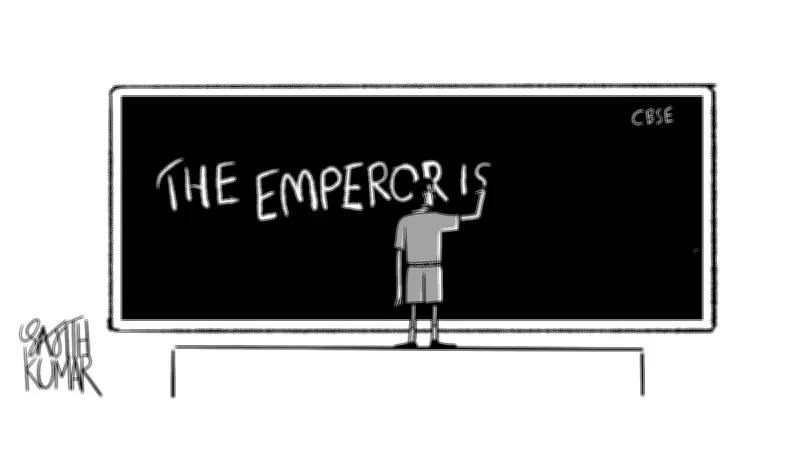
The Deccan Herald's latest cartoon takes a sharp jab at contemporary politics, drawing a clever parallel to Hans Christian Andersen's timeless fable, 'The Emperor's New Clothes.' In this modern rendition, the emperor is depicted as a political leader who, surrounded by sycophants and yes-men, remains blissfully unaware of the glaring truths that are obvious to the common citizen.
The Satirical Take
The cartoon illustrates a leader striding confidently, adorned in invisible garments, while his ministers and advisors praise his nonexistent attire. The public, however, sees the emperor for what he truly is—a figure stripped of substance, yet propped up by flattery and deception. This visual commentary resonates deeply in an era where political narratives often overshadow reality.
Blind Faith in Authority
The cartoon critiques the tendency of societies to place unwavering trust in their leaders, even when evidence suggests otherwise. It highlights how groupthink and fear of dissent can perpetuate falsehoods, allowing incompetence or corruption to go unchallenged. The emperor's new clothes symbolize the fragile constructs of power that collapse when exposed to honest scrutiny.

A Mirror to Modern Politics
From populist rhetoric to image management, the cartoon reflects how politicians often prioritize perception over performance. The fable's moral—that truth prevails despite collective denial—serves as a reminder for citizens to question authority and demand accountability. The artist's wit underscores the absurdity of political theater, where spectacle often trumps substance.
Conclusion
In essence, the cartoon is a call for critical thinking and courage in the face of political posturing. It urges readers to see beyond the facade and recognize the naked truths that lie beneath the surface of political grandstanding. As the fable teaches, it takes a child—or in this case, an artist—to point out that the emperor has no clothes.