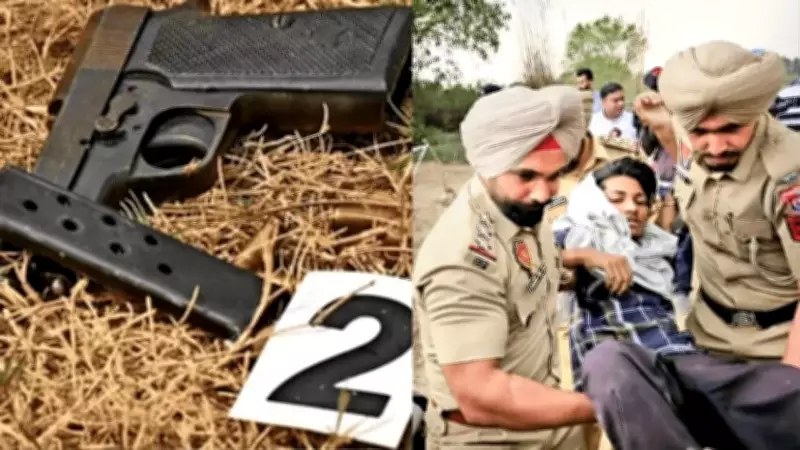
Driven by drugs and a lack of jobs, youngsters in Punjab are turning to killing for meagre sums as police grapple with new recruitment networks and a growing spate of crime. All it takes is a few thousands and some grams of heroin, a senior Punjab Police officer stated, highlighting how easy it has become to recruit killers amid a crime wave. The pipeline, steady and loaded, is being fed by drugs and unemployment, police say, as the drug addict today becomes tomorrow's assassin.
Paltry Sums for Deadly Acts
The purported sums paid for some recent crimes underline how youngsters are killing for nothing more than a pittance. For instance, the recent jobs for lobbing grenades on a police outpost in Patiala on April 1, 2025, and on another one in Haryana's Ajimgarh on April 6, 2025, went for just Rs 5,500 each. Those contracted were offered Rs 3-4 lakh but pulled the pin for a fraction, with the promise of being paid later. Similarly, the probe into the April 1 grenade blast outside the Punjab BJP headquarters in Chandigarh revealed that the two accused were promised Rs 2 lakh each but hurled the bomb after receiving Rs 19,000 in two instalments and a further Rs 18,665 in nine instalments. A gunman who fired at migrant workers in Moga in February this year got only Rs 7,500 from a foreign handler.
ISI Hand
Punjab has emerged as a key recruitment geography owing to high youth unemployment in rural and semi-urban belts, social media exposure to glorified gangster culture, and existing extortion and arms supply routes, said a senior officer. Security agencies also speak of a plot by Pakistan's Inter-Services Intelligence (ISI) to destabilise the border state through a nexus of terror operatives and gangsters. They point to the murder of two policemen at a checkpost in Gurdaspur on February 22, saying that one of the accused, Dilawar Singh, had received Rs 3,000 of the Rs 20,000 promised by ISI, which had plotted the attack. ISI had offered Rs 2-4 lakh to the three men involved, but they did it for far less, police said.

Investigation into major crimes shows how gangsters or ISI agents are increasingly picking young boys, even minors, drug addicts and the poor. They hail from such needy backgrounds, or are so desperate for drugs, that they are ready to kill anyone for Rs 10,000, a senior officer said. But not just drugs and money, in some cases, foreign-based radicals have also been known to lure youngsters by promising them foreign visas. We see a growing operational model wherein foreign-based handlers rely on psychological manipulation and false financial assurances rather than substantial payments. This is a serious security concern as it lowers the financial barriers to executing violent acts while increasing the risk of radicalisation and recruitment among economically vulnerable sections of society, said a senior police officer.
Another officer mentioned an ISI plot that was foiled on November 20, 2025, and led to the seizure of two hand grenades from Rajasthan-based suspects who were arrested after a police encounter in Ludhiana. Police discovered that the duo arrested had agreed to pull the pin for Rs 25,000. Another suspect, an addict, had earlier agreed to do the job for Rs 12,000 cash and 2 grams of heroin. Pakistan-based Shehzad Bhatti, Abid Jatt and Mussa Khan, who work at the behest of ISI, are trapping youngsters through social media. They have created multiple Instagram accounts through which they contact needy persons to work for them, added the official.
Low Risk, High Impact
A senior officer in Ludhiana recalled an extortion racket run by gangster Goldy Brar. We caught 10 local youths. Some were tasked with identifying businessmen who could be extorted, while others were asked to shoot at their residences to scare them. All these youngsters were promised Rs 10,000 for each task, along with drugs. Only two of them received some money as they had fired at a shop, he said. Multiple investigators shared that in most cases, those who carry out the crime do not even get the promised amount. They are initially given Rs 5,000 to Rs 8,000 with an assurance that they will get the rest after the task is completed. However, once it's done, the main conspirators cut them off, said one.

One of the accused involved in the two grenade blasts on July 19 last year at a Mohali police station received Rs 5,500 from a US-based handler while the alleged mastermind, Gurpreet Singh alias Babbu, who is lodged in Patiala jail, is said to have promised Rs 3-4 lakh, an officer said. It is a calculated approach; handlers exploit vulnerable individuals through false promises while minimising their own costs. The operatives are effectively treated as expendable assets, highlighting a growing trend of low-cost, high-impact operations driven by manipulation rather than genuine financial backing, the officer added.
Three-Step Process
But just how do these modules bait potential shooters and reel them in? Investigators say that, unlike earlier models that relied on hardened criminals, these networks now deliberately target unemployed or under-employed youth with clean records, making detection harder and arrests more disruptive to families and communities. What they rely on to land fresh recruits is a roughly three-stage process. They single out drug addicts, victims of enmity, or those with personal grudges. Some are also recruited on the basis of their religious beliefs or from gyms. Recruiters and gangsters also keep an eye out for youngsters whose social media activity shows fascination with guns, luxury, or gangster lifestyle, said the investigator.
Step 2 is when soft grooming takes place. This is when the recruiter avoids any mention of crime after establishing initial contact. It is more like a casual friendship, where small help in the form of cash is offered. Then comes a low-risk entry task, where the recruiter offers a minor assignment like delivering a parcel, arranging for a bike, watching a location, or buying SIM cards. It is only later that the criminal aspect of the task is revealed, the investigator said. Once the youth bite the bait, they are recruited as helpers and foot soldiers and assigned roles like reconnaissance of a target, transporting firearms and ammunition, and taking care of vehicles used in crimes. Interrogation of such youth has revealed a pattern where recruiters paid very little money in advance and left them to face the consequences. More often than not, it led to irreversible criminalisation, he pointed out.
Question of Jobs
Every officer TOI asked about the way out said what was needed was jobs and an all-out war on drugs. Give the youth jobs. Give them hope. Give them a salary to look forward to at the end of the month. Why would they risk a safe job for a risky crime that pays peanuts? Employment would solve much of the problem. It will make it easier for law enforcement to deal with the true criminal types. Now, you never know who will pick up a gun or a grenade, said an officer. Over 63,700 suspects have been arrested since Punjab government's anti-drug campaign, Yudh Nashian Viruddh, was launched earlier this year. Thousands of kilos of drugs have been seized, with Punjab Chief Minister Bhagwant Mann vowing to erase the blot of drugs.