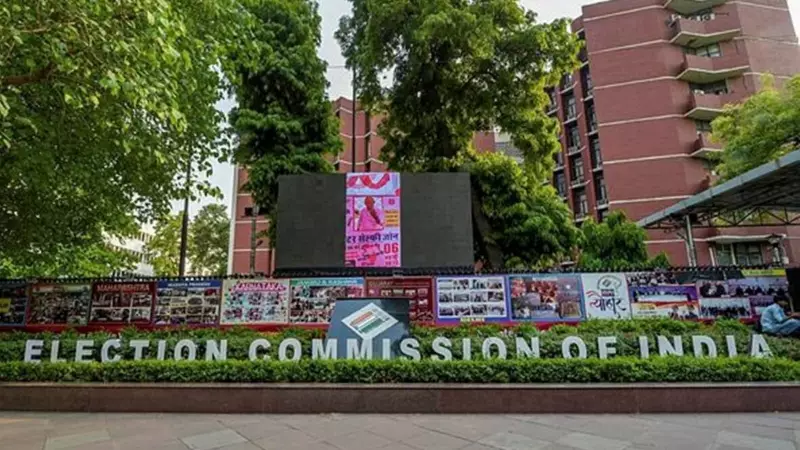
Election Commission Reaffirms Power to Examine Citizenship for Voter Lists
The Election Commission of India made a clear statement before the Supreme Court on Tuesday. It firmly stated that it possesses the authority to examine a person's citizenship status. This examination is crucial for deciding inclusion or exclusion from the voters' list.
Legal Framework and Arguments Presented
Senior Advocate Rakesh Dwivedi represented the Election Commission. He addressed a bench comprising Chief Justice Surya Kant and Justice Joymalya Bagchi. Dwivedi cited several legal provisions to support the Commission's position.
He specifically mentioned Article 326 of the Constitution, the Representation of the People Act of 1950, and the Registration of Electors Rules from 1960. According to Dwivedi, these laws collectively empower the Electoral Registration Officer to make determinations about citizenship for electoral purposes.

"The Electoral Registration Officer is competent to take a view on this matter," Dwivedi told the court. He emphasized that an inquisitorial enquiry into citizenship is permissible for specific purposes like voter registration.
Analogies and Practical Examples
To illustrate his point, Dwivedi drew a parallel with other government processes. He referenced the Mines and Minerals Act of 1957. This law requires applicants for mining leases to be Indian citizens.
"When someone applies for a mining lease, the relevant authority will certainly examine whether the applicant is a citizen or not," he explained. He argued that similar verification logic applies to the electoral process.
Court's Questions and Commission's Clarifications
Justice Bagchi posed an important question during the hearing. He asked whether the Electoral Registration Officer can refer findings of non-citizenship to the Central government. The concern was about stripping voting rights before a final government decision.
Dwivedi clarified the distinct roles. He stated that the government's decision would focus on a person's right to stay in India or face deportation. However, for matters concerning the electoral roll, the Election Commission holds the primary power.
"That's enough to strike him off the electoral roll," Dwivedi asserted regarding an officer's finding of non-citizenship. He also noted that references to the government could sometimes result in a favorable outcome for the individual, leading to re-inclusion.
Safeguards and Constitutional Considerations
The senior counsel highlighted existing safeguards for aggrieved persons. He warned against the alternative scenario. "The consequence of taking the other view would be problematic," he said. He explained that even if an officer finds someone is not a citizen, they might still be included and allowed to vote without proper checks.
Dwivedi pointed out a lingering constitutional question. Article 326 does not specify how to decide citizenship. He noted that the Constitution's initial articles regarding citizenship are transitional, dealing with the country's commencement.
"These sections do not help us in deciding citizenship today. They furnish no criteria for deciding how," he stated. However, he acknowledged they indicate the importance of domicile, residence, and birth in India.
Justice Bagchi offered a different interpretation. He suggested Article 5 extends citizenship beyond commencement due to clauses about parents. Dwivedi acknowledged this perspective but pointed to subsequent citizenship laws that modify and extend criteria.
The Supreme Court hearing on this significant matter will continue on January 15. The discussions delve deep into the intersection of citizenship rights and electoral integrity in India.