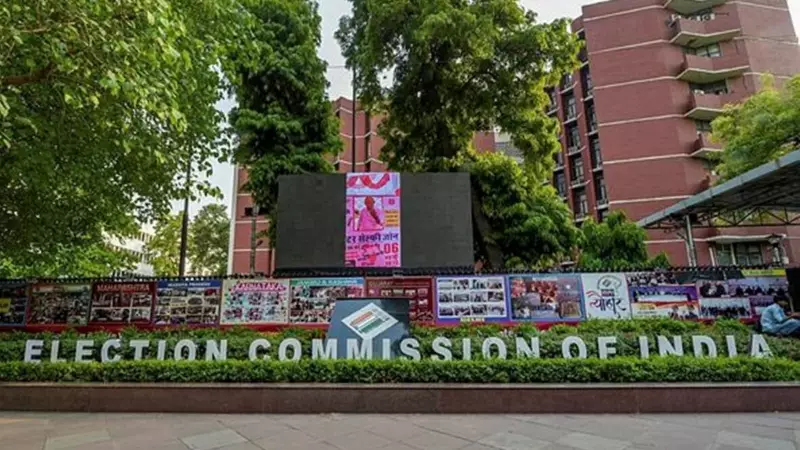
The Election Commission of India made a significant statement before the Supreme Court on Tuesday. It firmly stated that electoral authorities possess the right to examine a person's citizenship status. This examination determines inclusion or exclusion from the voters' list.
Legal Authority for Citizenship Scrutiny
Senior Advocate Rakesh Dwivedi represented the poll body before a bench led by Chief Justice Surya Kant and Justice Joymalya Bagchi. He argued that the Electoral Registration Officer holds this competence. This power stems from Article 326 of the Constitution, the Representation of the People Act of 1950, and the Registration of Electors Rules from 1960.
"The EC, through the designated officer, is competent to take a view," Dwivedi told the court. He emphasized that an inquisitorial enquiry into citizenship can indeed occur for specific electoral purposes.

Comparing with Other Legal Frameworks
To illustrate his point, Dwivedi referenced existing laws. He mentioned the Mines and Minerals Act of 1957. This act requires an applicant for a mining lease to be an Indian citizen. "When somebody applies, the authority will certainly examine whether he is a citizen or not," he explained. He suggested a similar logic applies to electoral rolls.
Safeguards and Consequences
Justice Bagchi raised a crucial question. He asked if referring a finding of non-citizenship to the central government, before its decision, aligns with the Citizenship Act. Could this strip voting rights prematurely?
Dwivedi clarified the roles. He said the government's decision concerns a person's right to stay in India or face deportation. However, for the electoral roll itself, the Election Commission holds the power. "That's enough to strike him off the electoral roll," he asserted.
The senior counsel also highlighted safeguards. He noted that references might sometimes favor the concerned person. In such cases, re-inclusion in the voter list would follow. "The consequence of the other view would be problematic," Dwivedi argued. He stated that if an officer finds someone is not a citizen, yet includes them anyway, that person could still vote. Once a legitimate shadow is cast on citizenship, that person needs to stand out from the roll.
Constitutional Interpretation and Future Criteria
The discussion delved into constitutional interpretation. Dwivedi pointed out that Article 326 does not specify how to decide citizenship. He noted we are no longer in the 1950s. The Constitution outlines citizenship at its commencement in Articles 5, 6, and 7, but not continuously thereafter.
Chief Justice Surya Kant observed these articles are transitional. They addressed people needing to decide where to settle after the country's creation.
"These sections do not help us in deciding citizenship today," Dwivedi said. "They furnish no criteria for deciding how, but they do tell us that domicile, residence, and birth in India are important. The most important is birth."
Justice Bagchi offered a different perspective. He noted Article 5 extends citizenship beyond commencement because of a clause about parents being born. Therefore, children of those persons also derive citizenship from it.
Dwivedi acknowledged this view. "That's one way of looking at it," he said. He added that Section 3 of the Citizenship Act extends similar criteria for the future, with significant modifications that must be remembered.
Ongoing Legal Proceedings
The bench is currently hearing petitions. These petitions challenge the constitutional validity of the Summary Revision of electoral rolls, known as the SIR exercise, undertaken in various states. The hearing will continue on January 15, allowing for further legal arguments on this complex issue.