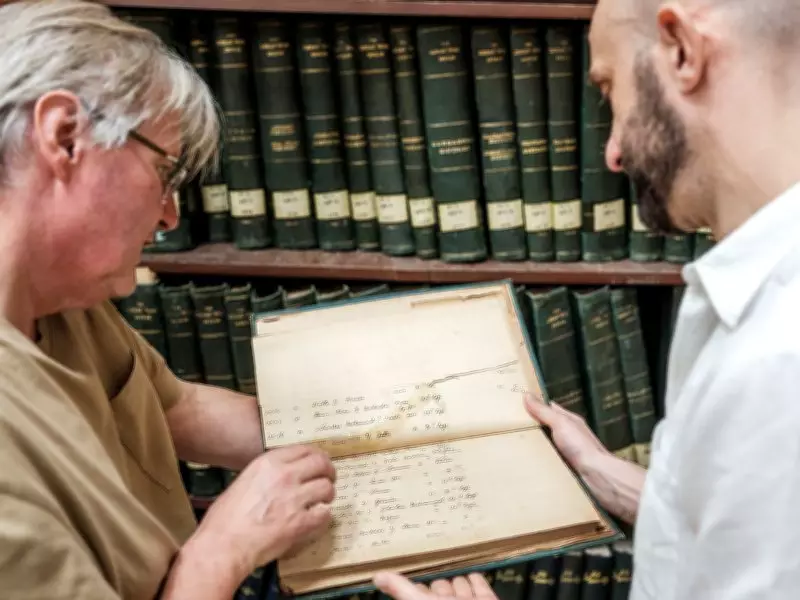
The Commonwealth War Graves Commission (CWGC) has announced that 9,909 previously unrecorded Indian servicemen who died in World War I will finally be commemorated, following a decade-long research project centred on a remarkable archive of 34 handwritten Punjab Registers discovered in the Lahore Museum, Pakistan. This is one of the largest single additions ever made to the Commission’s casualty records.
Discovery of the Punjab Registers
In 2014, Amandeep Madra, co-founder of the UK Punjab Heritage Association, found the 34 handwritten volumes during research for the Empire, Faith & War project. The registers contain systematic records of every Punjabi man who served in the Indian army during the First World War, totalling around 320,000 names. “Military historians knew the registers existed in principle, but no one had gone to look,” Madra recalled. “I knew straightaway it was significant.”
A Decade of Painstaking Work
The 26,000 pages were photographed, digitised, indexed, and transcribed over more than 10 years, involving collaboration between the UK Punjab Heritage Association, the University of Greenwich, and the CWGC. Prof Gavin Rand of the University of Greenwich secured funding for transcription, while the CWGC compared the data with its casualty database. Researchers examined almost 16,000 recorded deaths against some 74,000 existing Indian army casualty records, identifying 9,909 men never previously commemorated.

Why These Soldiers Were Forgotten
Dr George Hay, Official Historian at the CWGC, explained that the British Indian Government made a conscious decision not to extend full war graves status to Indian army soldiers who died at home or away from operational zones. Many survived battlefields only to die later from wounds or disease after returning to India. Unlike British soldiers, their names were never passed on for permanent commemoration. Administrative failures also caused some operational casualties to disappear from the record. The findings reinforce conclusions of the CWGC’s Special Committee on Historical Inequalities in Commemoration (established 2021) that entrenched racial prejudice and discriminatory colonial attitudes contributed to unequal commemoration.
Personal and Social Significance
For Madra, the project became deeply personal when he found his own relative, Bishen Singh, in the Ambala district register. “It’s probably the only surviving record where both his name and his father’s name still exist,” he said. The registers also provide an unparalleled census of rural Punjab on the eve of modern history, recording soldiers’ religion, caste, father’s name, village, and district. Approximately 41% of the newly identified casualties were Muslim, 26% Hindu, 25% Sikh, and less than 1% Christian.
Cross-Border Collaboration
The research crossed modern borders, with British and Punjabi scholars working alongside archivists in Pakistan, and transcribers in both India and Pakistan converting handwritten pages into searchable data. “It isn’t an Indian story or a Pakistani story,” Madra said. “It’s a shared Punjabi story.”
Impact on Descendants
Among those newly recognised is Jagat Singh of the 34th Reserve Mountain Battery, who died in Mesopotamia in January 1918. His great-granddaughter, Manjinder Nagra, became the first Sikh woman to play rugby for England. Leicester dentist Dr Inder Singh Palahey, whose great-grandfather Kesar Singh was also identified, said, “From just hearsay to now discovering the facts about my great-grandfather’s ultimate military sacrifice has been incredibly poignant. The fact that he will now be remembered in perpetuity simply means everything to us.”
Future Plans
The CWGC hopes to create a public, searchable database allowing descendants to trace relatives and add family histories. Madra believes the men should ultimately be commemorated physically, with their names carved in stone, like other Commonwealth war dead. The work continues, as similar archives may survive elsewhere in the former British Empire, raising the possibility of finding more forgotten soldiers.