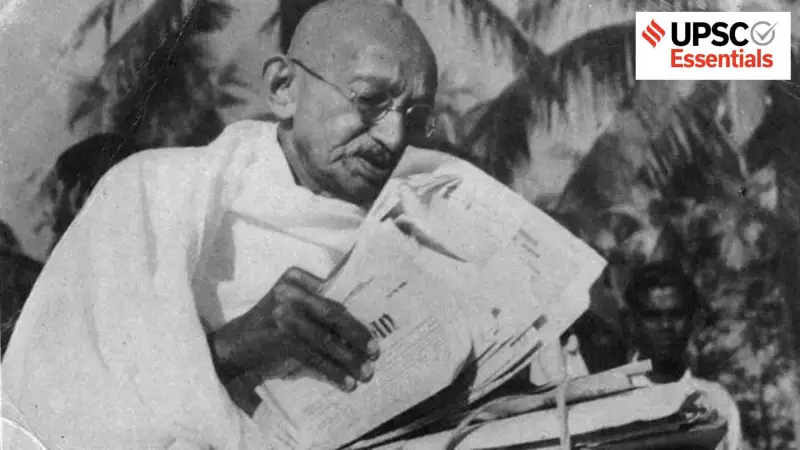
How Gandhi’s Writings Continue to Reshape Global Politics and Everyday Life
Mahatma Gandhi was primarily a karmayogi—a man of selfless action—rather than a philosopher engrossed in abstract theories. Yet, his writings, deeply rooted in spiritual experiments and public engagement, maintain a profound and lasting influence on both global politics and the fabric of everyday life. A careful and deeper reading of Gandhi's works is essential to grasp the subtleties of his political and ethical ideas for their meaningful application in contemporary contexts.
The Blending of Politics and Morality in Gandhi’s Works
Although Gandhi was not chiefly a writer or philosopher, his extensive writings have indelibly shaped the moral and political vocabulary of daily existence. As a leader of India's national movement, he addressed political challenges faced by colonized peoples worldwide, but his scope extended far beyond politics into the realms of health, religion, and ethics. His popular works, such as Hind Swaraj (1909), The Story of My Experiments with Truth (1929), and Conquest of Self (1943), exemplify this complex intermixing of ideas, blurring the boundaries between public action and personal morality.
Hind Swaraj: The Foundation of Gandhian Ideology
Gandhi penned his first political treatise, Hind Swaraj or Indian Home Rule, in just ten days in November 1909 while traveling from London to South Africa. Originally written in Gujarati and later self-translated into English, this work was a direct response to the defense of violence by some Indian revolutionaries, such as Madan Lal Dhingra. Gandhi argued that while political unrest could awaken colonized people, violent means would ultimately render a future nation soulless. He championed the force of love over brute force, emphasizing an inviolable connection between means and ends, illustrated through the analogy of seeds and trees.

In Hind Swaraj, Gandhi also delivered a scathing critique of modernity, challenging Western civilizational superiority by prioritizing spirituality over material comforts. He asserted that true Swaraj (self-rule) could only be achieved by escaping the grip of modern civilization, which he viewed as rooted in irreligion and violence. This text laid the ideological groundwork for his later tools, including nonviolence, passive resistance, and his vision for Indian education.
Conquest of Self: The Cornerstone of Moral Philosophy
Conquest of Self, a compilation of Gandhi’s speeches and writings, forms the bedrock of his moral philosophy. It delves into themes like celibacy (brahmacharya), self-restraint, ideal marriage, women's rights, health, and diet. Gandhi defined brahmacharya as the control of all senses in thought, word, and deed, believing that such discipline fosters freedom from sin and immunity to diseases. He argued that self-restraint is an escape from harmful animal passions, with Truth serving as the core principle of all virtues.
For Gandhi, nonviolence, grounded in universal love, cannot be practiced without observing brahmacharya. Thus, truth and nonviolence, rooted in this self-discipline, became the touchstones of his politics and morality, opposing any actions or ideas that deviated from these twin virtues.
The Story of My Experiments with Truth: A Diary of Confession
Unlike conventional autobiographies, Gandhi’s memoir reads as a diary of confession, detailing his struggles, failures, and constant self-questioning. Serialized in his Gujarati journal Navajivan from 1925 to 1929, it interweaves political and personal life, tracing the roots of his ethical philosophy, including ahimsa (nonviolence), satyagraha (truth force), and his views on health. The narrative emphasizes that personal discipline and spiritual striving are inseparable from public action, with Gandhi equating Truth with God and preaching humility and self-discipline as paths to seeking it.

The book also offers rich accounts of his unique political methods in South Africa and India, presenting his experiments as a genuine dialogue with readers, convincing them that his principles are accessible to all, even a child.
The Continuing Resonance of Gandhi’s Ideas
Gandhi’s writings provide a timeless grammar of resistance, inspiring socio-political movements worldwide, from civil rights to environmental activism. Figures like Martin Luther King Jr. and Nelson Mandela drew from his moral vocabulary, which remains relevant in contemporary conflicts, such as the Russia-Ukraine war. His critique of consumerism and materialism offers insights for addressing modern global challenges, highlighting how Gandhian ethics can contribute to conflict resolution.
In essence, Gandhi was not merely a political leader but a moral philosopher in action. His works continue to shape discussions on violence, truth, and colonialism, underscoring the need for a deeper engagement with his ideas to navigate today’s complex political and ethical landscapes.