

From Sacred Ritual to Political Stage
Guru pooja began as a solemn Hindu ritual. People practiced it on the death anniversary of their mentors. This tradition traces its roots back to the Sangam period. During that ancient time, people knew it as 'Thenpulathaar'. This term referred to departed souls believed to reside in the southern direction.
The Spiritual Foundations
Poet-saints of the Saivite tradition received veneration through this practice. The 63 Nayanmars and various ascetics were honored in this manner. For centuries, guru pooja remained a spiritual observance. It focused on remembrance and respect for philosophical guides.
The Political Turn
The 1960s marked a significant shift. Politics and the symbolism of guru pooja began to intersect during this period. Popular leaders started receiving treatment previously reserved for spiritual figures. Followers began placing them on par with gods.

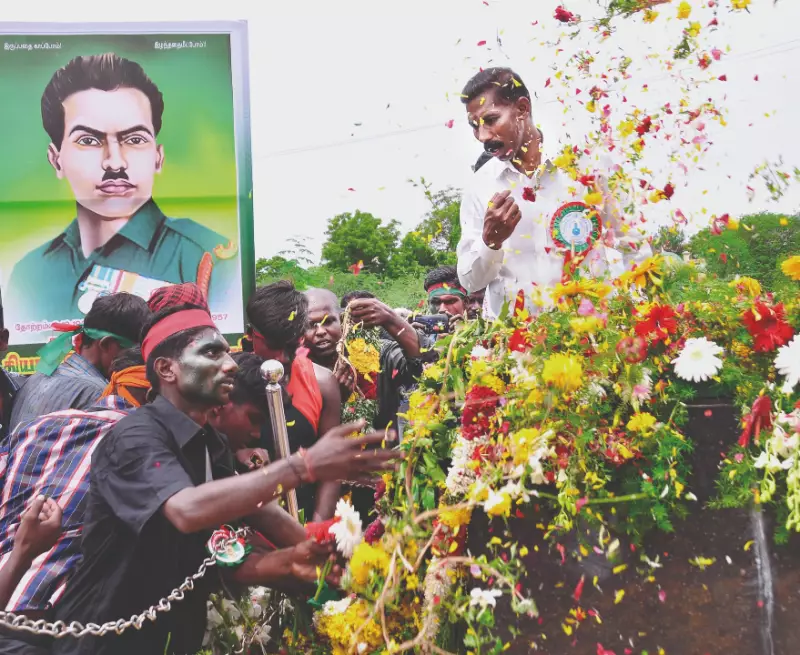
Pasumpon Muthuramalinga Thevar became a central figure in this transformation. His followers considered him their philosophical guide. For decades, guru pooja became almost synonymous with Muthuramalinga Thevar. The ritual started acquiring political dimensions during his time.
Modern Proliferation
The past two decades have witnessed further expansion. Various community welfare associations have risen during this period. Social media has become prevalent across society. Many caste groups believe these platforms help shape public perception.
As a result, guru poojas now occur throughout the year. These include several prominent observances:
- Immanuel Sekaran guru pooja honors the civil rights activist and Indian National Congress party worker
- Vanniyar guru pooja happens on the death anniversary of PMK's Kaduvetti Guru
- Marudhu Pandiyar guru pooja maintains its own traditions
- VOC guru pooja continues to draw participants
The RSS in Tamil Nadu celebrates 'RSS guru pooja'. This observance remembers the organization's founders. The latest addition to this growing list is the Vijayakant guru pooja. It honors the DMDK founder who died in 2023.
Electoral Implications
The Vijayakant guru pooja recently drew particular attention. This interest connects directly to the upcoming 2026 assembly election. DMDK has not yet announced its position on a poll alliance. The party no longer commands the vote share it achieved in 2006, 2011, and 2016.
However, political observers note an important factor. Vijayakant's mass appeal remains strong among lower socio-economic groups. Many believe the party's presence in an alliance could offer an added edge. This potential advantage makes the guru pooja observation politically significant.
Official Perspectives
R Mohanraj serves as DMDK's propaganda secretary. He offers a different perspective on the practice. "There is no politics in observing the death anniversary of our 'Captain' as guru pooja," he states firmly. "He is our guiding star, our guru. It is out of love and loyalty that we observe the day as guru pooja."
Mohanraj makes an important distinction about crowd participation. He notes that other parties often bring people in vans during anniversary events. This transportation serves as a show of strength. According to him, the crowd for Vijayakant is not "orchestrated" in this manner.
"Our partymen comprise only half the crowd," he explains. "The rest come because they love him. They bring utensils, cook food and serve those who visit his memorial."
Government Recognition
M G Ramachandran's rule in 1979 marked another milestone. 'Thevar guru pooja' received official recognition from the state during his administration. From that point forward, the event has been celebrated as a government function.
P Ramajayam serves as assistant professor at the Centre for the Study of Social Inclusion, Bharathidasan University in Trichy. He analyzes the political impact of this decision. "The AIADMK government's decision to celebrate Thevar guru pooja as a government function is one of the reasons a large number of mukkulathor votes are still cast for the party," he observes.

The term 'mukkulathor' serves as an umbrella designation. It encompasses the kallar, maravar and agamudaiyar clans of south Tamil Nadu. Ramajayam notes that this terminology gained prominence during the Dindigul byelection. This contest represented the first election faced by AIADMK where K Maya Thevar from the mukkulathor community contested against DMK's Pon Muthu Ramalingam, who also came from the same community.
"Until then, there was a nadar dominance in the south and most were Congress supporters," Ramajayam explains. "That dominance was diluted by the social mobilisation of mukkulathor."
Beyond Community and Politics
R Sundara Vanthiya Thevan provides deeper historical context. He is a Madurai-based author and advocate who wrote 'Piramalai Kallar Vaazhvum Varalaarum'. This ethnographic study examines the piramalai kallar community of Tamil Nadu. The British once labelled this group a 'criminal tribe'. It now holds denotified community status.
Thevan argues that the guru pooja for Muthuramalinga Thevar transcends simple categorization. "Muthuramalinga Thevar said patriotism and spirituality were his two eyes," he recounts. "Though he came from the well-off maravar community, he worked hard for the uplift of criminal tribes. In gratitude, denotified communities began paying respect to him on his death anniversary."
The terminology itself has evolved over time. "In the early years, people celebrated his death anniversary as 'Thevar Jayanthi'," Thevan notes. "When he was alive, his Forward Bloc party celebrated 'Netaji Jayanthi', similar to 'Gandhi Jayanthi'. The term guru pooja has come into popular parlance only in the past 20 years, particularly after the emergence of caste-based political parties in the 1990s."
This linguistic shift reflects broader social changes. What began as spiritual remembrance has transformed into a complex socio-political phenomenon. Guru pooja now serves multiple purposes across Tamil Nadu's cultural and political landscape.





