

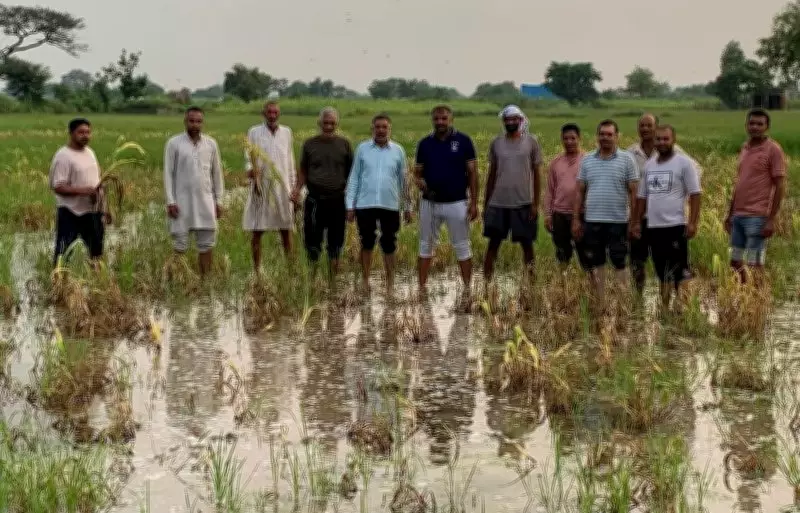
Haryana Government Disburses Rs 6.46 Crore Crop Relief in Meham Amid Farmer Protests
The Haryana state government has released a compensation package of Rs 6.46 crore to address kharif crop losses suffered by farmers in the Meham Assembly constituency. This financial relief has been directly transferred into the bank accounts of 8,676 eligible farmers across 23 villages, following extensive damage caused by prolonged waterlogging due to excessive rainfall during the last monsoon season.
Compensation Details and Verification Process
According to Haryana Revenue Minister Vipul Goel, the compensation was disbursed in December 2025 after a rigorous verification process. All claims submitted by farmers on the e-Kshtripti portal up to September 15, 2025, were scrutinized by field revenue officers, including patwaris, kanongos, CROs, SDMs, deputy commissioners, and divisional commissioners. This data was cross-referenced with information from the Agriculture Department on the PMFBY portal and the E-Kharid portal of the Food, Civil Supplies and Consumer Affairs Department to ensure accuracy and prevent fraud.
Village-wise breakdown of the compensation includes significant payouts such as Rs 1.41 crore to 540 farmers in Bhaini Surjan, Rs 2.20 crore to 879 farmers in Samain, and Rs 2.43 lakh to 1,011 farmers in Behalba. Other villages like Bhaini Maharajpur, Bhaini Bharon, and Bhaini Chander Pal also received substantial amounts, highlighting the widespread impact of the waterlogging issue.

Kisan Sabha Alleges Widespread Exclusion
Despite the government's efforts, the All India Kisan Sabha (AIKS) has raised serious concerns, alleging that a large number of affected farmers have been left out of the compensation process. The farm outfit claims that only about 25% of the impacted farmers have received relief, leaving nearly 75% without financial support. AIKS leaders have been staging protests and submitting memorandums to authorities, demanding that all eligible farmers be compensated.
Sumit Dalal, district secretary of AIKS, accused the government of cheating farmers by denying compensation for losses of paddy, bajra, and cotton crops destroyed due to waterlogging. He stated that standing crops across large agricultural areas in several villages were inundated, but compensation was released to only a limited number. Dalal further alleged that the government used pretexts such as duplicate photographs and crop insurance claims to deny payments, creating resentment among the farming community.
Political and Administrative Responses
The issue came to the forefront during the ongoing Budget session of the Vidhan Sabha, where Congress MLA Balram Dangi from Meham questioned the government about the compensation disparity. He inquired whether only a quarter of affected farmers had been paid, while the majority remained deprived, and sought details on steps to compensate the remaining farmers and the timeline for releasing pending amounts.
In response, Minister Vipul Goel emphasized the government's commitment to supporting farmers, citing the comprehensive verification process and adherence to norms. However, AIKS state vice-president Preet Singh countered that large tracts of agricultural land in several villages remain waterlogged, preventing farmers from sowing rabi crops. He criticized the government for not reopening the compensation portal and vowed to continue agitating until all demands are met.
Long-Term Flood Mitigation Initiatives
To address the chronic issue of waterlogging, the district administration and the Irrigation and Water Resources Department have initiated comprehensive flood mitigation and drainage improvement measures. Recently approved by the Haryana State Drought Relief and Flood Control Board, these projects are valued at Rs 53 crore and aim to protect thousands of acres of farmland in vulnerable villages.

An official explained that the initiatives include laying underground RCC and HDPE pipelines of varying diameters, installing sump wells and pumping machinery, constructing RCC protection structures along vulnerable drains, and developing vertical drainage systems using submersible pumps. In the Meham area, villages like Bhaini Surjan, Bhaini Chanderpal, Saiman, Farmana, Bhalba, and Loharheri, which frequently face monsoon flooding, will benefit from these measures. Key strategies involve channeling excess water into the Jui Feeder, Meham Drain, and Pakasma Drain through new pipelines and pumping stations to accelerate dewatering.
Similar projects are planned in the Sampla area, where pipelines and pumps will divert flood water into the Aasan and Makrauli Link Drain for faster drainage and enhanced protection of agricultural land. These efforts are expected to significantly strengthen the district's flood management infrastructure and reduce future crop losses caused by prolonged water stagnation during heavy rainfall.
As the situation unfolds, the conflict between the government's compensation disbursement and the farmers' demands for inclusivity continues to escalate, with AIKS warning of intensified agitation if left-out farmers are not provided relief. The ongoing protests and political debates highlight the urgent need for transparent and equitable solutions in agricultural crisis management.





