

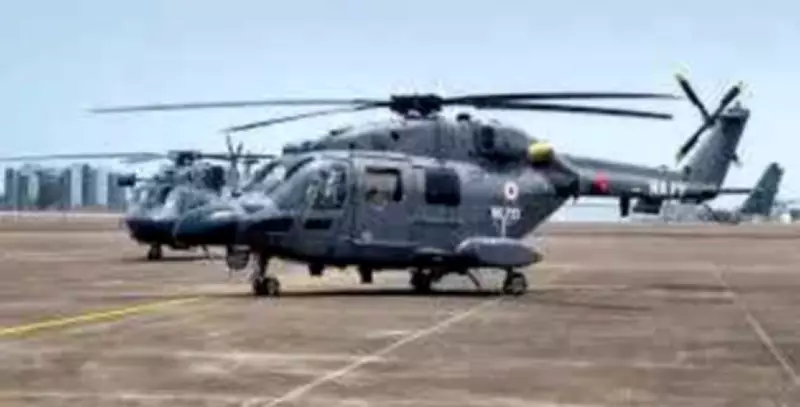
IAF Pioneers Indigenous Helicopter-Dropped Drone Initiative
In a significant advancement for India's defense capabilities, the Indian Air Force (IAF) has commenced work on the nation's inaugural helicopter-dropped drone project, named 'Vayu Baan' (air arrow). This development comes as drones increasingly dominate modern warfare scenarios globally, highlighting the strategic importance of unmanned systems in contemporary conflicts.
Unveiling the Vayu Baan Program
Vayu Baan represents a cutting-edge indigenous air-launched effects (ALE) program, meticulously designed to seamlessly integrate unmanned aerial systems with manned rotary-wing platforms. The drone is engineered as a compact, autonomous unit that can be deployed from a moving helicopter during flight. Upon release, it unfolds its wings, activates its propulsion system, and functions either as a sophisticated surveillance tool or a precision-guided munition, commonly referred to as a kamikaze drone.
This homegrown initiative is spearheaded by the IAF's Directorate of Aerospace Design (DAD) based in Gandhinagar. The directorate has recently issued a request for proposal (RFP), actively soliciting bids from domestic vendors for the comprehensive design and development of the system. The IAF's objective is to expedite the entire process, targeting development, rigorous testing, and final delivery within a tight timeframe of one year.

Technical Specifications and Operational Capabilities
Once airborne, Vayu Baan is equipped to transmit real-time video feeds directly to operators, ensuring enhanced situational awareness. If the mission demands, it can execute precision strikes utilizing a small warhead onboard. Key technical features include:
- A projected operational range exceeding 50 kilometers.
- An endurance of approximately 30 minutes per flight.
- Advanced electro-optical and infrared sensors for precise target identification.
- Robust functionality in GPS-jammed environments, ensuring reliability in contested airspace.
The IAF has outlined a requirement for 10 drone units, complemented by two airborne control stations and two ground control stations, underscoring the program's scale and strategic intent.
Global Context and Strategic Implications
With the launch of Vayu Baan, the IAF is poised to enter an elite league of nations, including the United States and China, that are actively developing air-launched unmanned systems. The U.S. Army, for instance, is heavily investing in ALEs as a core component of its future vertical lift ecosystem. Notable technologies in this domain include the Area-I ALTIUS (agile-launched, tactically integrated unmanned system), which has been successfully trialed from MH-60 Black Hawk helicopters.
Similarly, China is focusing on integrating unmanned rotary-wing aircraft with its existing helicopter fleets, such as the Z-20J, Z-10, and Z-19 models. This global trend underscores the transformative role of drones in enhancing military agility, reconnaissance, and strike capabilities.
The Vayu Baan project not only marks a milestone in India's defense innovation but also aligns with broader efforts to bolster self-reliance in critical military technologies. As conflicts evolve, such initiatives are crucial for maintaining strategic parity and operational effectiveness on the modern battlefield.






