

India's 77th Republic Day Celebrates Constitutional Legacy with Global Flair
As the nation commemorated its 77th Republic Day, the iconic Kartavya Path in New Delhi transformed into a vibrant tableau of national pride and strategic messaging. President Droupadi Murmu presided over the ceremonial unfurling of the Tiranga, marking another chapter in India's enduring democratic tradition. The presence of distinguished European leaders—European Commission President Ursula von der Leyen and European Council President Antonio Costa—highlighted India's expanding diplomatic footprint on the global stage.
Military Innovations and Strategic Messaging
The 2025 Republic Day parade carried particular significance against the backdrop of Operation Sindoor, launched earlier that year. For the first time in history, spectators witnessed the Indian Army's revolutionary "Battle Array Format," which seamlessly integrated ground forces with aerial elements in a coordinated display of tactical prowess. The parade featured groundbreaking indigenous defense systems, including a high-mobility reconnaissance vehicle and India's first domestically developed armored light specialist vehicle.
Perhaps the most historic moment came with the participation of a European Union military contingent, marking the EU's debut in a military parade outside European territory. The contingent proudly carried military staff flags alongside banners representing EU naval missions Atalanta and Aspides, symbolizing deepening defense cooperation between India and European nations.

From Colonial Pathways to Republican Promenades
The ceremonial journey of Republic Day celebrations has mirrored India's own transformation from colonial subject to sovereign republic. The parade route has evolved significantly since that historic morning of January 26, 1950, when India's first President, Rajendra Prasad, unfurled the national flag at Irwin Stadium near Rashtrapati Bhavan.
The colonial Kingsway transformed into Rajpath before receiving its current designation as Kartavya Path, reflecting the nation's journey from imperial rule to constitutional governance. Each year, the 31-gun salute near India Gate echoes that original proclamation of sovereignty, reminding citizens of the constitutional framework that has guided the nation for over seven decades.
The Dawn of Republican India
At precisely 10:18 AM on January 26, 1950, inside the magnificent Durbar Hall of what is now Rashtrapati Bhavan, India formally shed its Dominion status to emerge as a sovereign democratic republic. Chakravarti Rajagopalachari, the last Governor-General, read the proclamation declaring "India, that is Bharat" as a Union of States under its newly adopted Constitution.
Minutes later, Rajendra Prasad assumed office as India's first President, addressing a nation of approximately 320 million people in both Hindi and English. His speech celebrated the unification of diverse regions under a single constitutional framework, from Kashmir to Cape Comorin and from Kathiawad to Kamrup.
Public Celebrations and Symbolic Choices
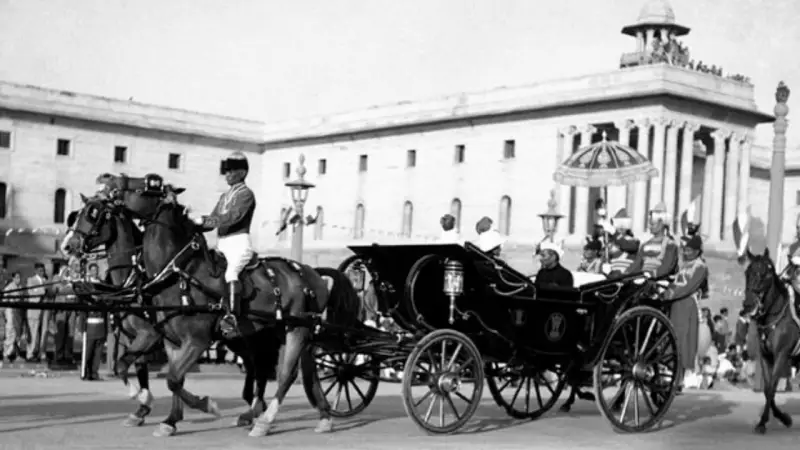
While constitutional formalities unfolded within government halls, approximately 15,000 citizens gathered at the Irwin Amphitheatre to witness India's first Republic Day parade. President Prasad rode through Delhi's streets in an open buggy without security cover, greeted by enthusiastic crowds shouting "jai" from rooftops, trees, and balconies.
The choice of January 26 carried profound historical resonance, as this date had been observed as Purna Swaraj Diwas since the Indian National Congress's Lahore session in December 1929. The transition from colonial Independence Day celebrations to republican constitutional commencement represented the fulfillment of the freedom movement's aspirations.
Evolution of a National Tradition
Since moving to Rajpath in 1955, the Republic Day parade has grown into a comprehensive showcase of India's military capabilities, cultural diversity, and developmental achievements. The event now includes:

- State and Union Territory cultural tableaux
- Display of indigenous defense technologies
- Conferral of Padma awards recognizing civilian excellence
- Participation of international dignitaries as chief guests
From Cold War allies to contemporary strategic partners like Vladimir Putin and Barack Obama, the parade has hosted leaders representing diverse geopolitical alignments. Yet through all transformations, Republic Day remains fundamentally anchored to that winter morning in 1950 when India committed itself to democratic governance, constitutional supremacy, and popular sovereignty.
The spectacle continues to evolve with changing times and strategic priorities, but the essential promise of that first Republic Day—of a nation governed by law, democracy, and the collective will of its people—remains as vital today as it was seventy-seven years ago.





