How India Pulled Off the World's Most Complex Constitution: A Historical Insight
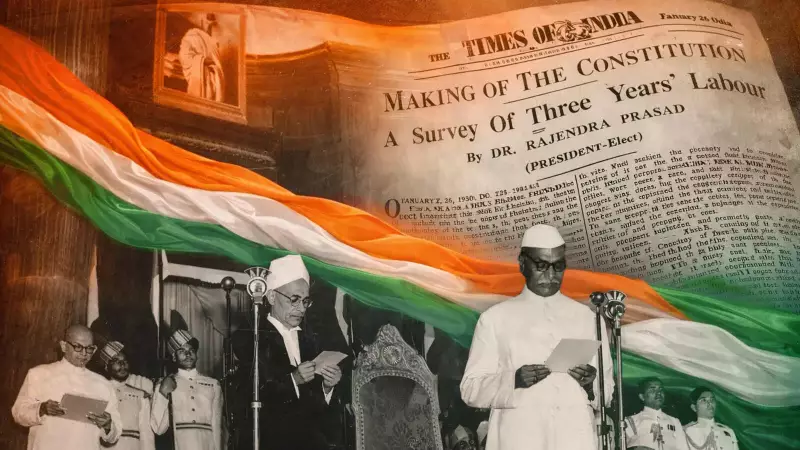
In the words of India's first President, Dr. Rajendra Prasad, the creation of the Indian Constitution stands as a monumental achievement in global history. This document, often hailed as the world's most complex, was not merely drafted overnight but emerged from a meticulous and arduous process that began well before India's independence in 1947.
The Prelude: The 1946 Cabinet Mission
On March 15, 1946, a pivotal moment unfolded when British Prime Minister Clement Attlee made a significant announcement. He declared that a Cabinet Mission, comprising Lord Pethick-Lawrence, Sir Stafford Cripps, and Mr. Alexander, would be dispatched to India. Their mission was clear: to use their utmost endeavours to help India attain her freedom as speedily and fully as possible. Attlee emphasized that the form of government to replace the British regime was for India to decide, but Britain's desire was to assist in setting up the machinery for making that crucial decision.
This announcement marked the beginning of a critical phase in India's constitutional journey. The Cabinet Mission's arrival set the stage for negotiations and discussions that would shape the future governance of the nation.

The Constitutional Assembly and Its Challenges
Following the Cabinet Mission's efforts, the Constituent Assembly of India was formed in 1946, tasked with the herculean job of drafting a constitution for an independent India. The assembly comprised 299 members, representing diverse regions, communities, and ideologies across the country. Dr. Rajendra Prasad, who later became India's first President, served as the President of the Constituent Assembly, guiding its deliberations with wisdom and foresight.
The challenges were immense: India was a vast and diverse land with multiple languages, religions, and cultural traditions. The constitution had to balance unity with diversity, ensuring rights and protections for all citizens while establishing a robust framework for democracy, federalism, and social justice.
The Drafting Process and Global Influences
The drafting committee, led by Dr. B.R. Ambedkar, worked tirelessly for nearly three years, from 1947 to 1949. They drew inspiration from various sources, including the constitutions of other nations such as the United States, United Kingdom, and Ireland, while also incorporating unique Indian elements like the Directive Principles of State Policy.
Key features of the Indian Constitution include:
- Length and Detail: With over 470 articles and 12 schedules, it is one of the longest written constitutions in the world.
- Fundamental Rights: Guaranteeing civil liberties such as equality, freedom, and protection against exploitation.
- Federal Structure: Establishing a union of states with a strong central government.
- Secularism and Social Justice: Promoting religious freedom and measures for the upliftment of marginalized communities.
The process involved intense debates, compromises, and a commitment to inclusivity, reflecting the spirit of the freedom struggle.
Adoption and Legacy
The Constitution of India was finally adopted on November 26, 1949, and came into effect on January 26, 1950, marking India's transition to a republic. Dr. Rajendra Prasad, in his role as the first President, often reflected on this achievement, noting how it embodied the aspirations of millions of Indians for a just and democratic society.
Today, the Indian Constitution remains a living document, amended over time to address evolving needs, yet its core principles continue to guide the nation. Its complexity is not just in its length but in its ability to harmonize diverse elements into a cohesive whole, a testament to the vision and perseverance of its framers.
In summary, the journey from the 1946 Cabinet Mission to the adoption of the Constitution showcases India's remarkable feat in pulling off what is widely regarded as the world's most complex constitutional framework, a legacy that endures in the democratic fabric of the country.