

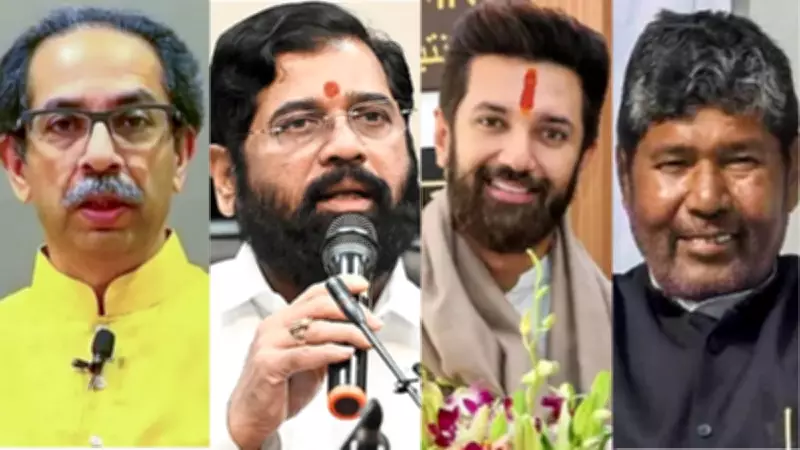
The political landscape of India has witnessed several party splits over the years, reshaping the dynamics of state and national politics. From the Shiv Sena to the AIADMK, these divisions have created both winners and losers, altering the balance of power in various regions.
Shiv Sena: A Tale of Two Factions
The Shiv Sena, once a dominant force in Maharashtra, experienced a significant split in 2022 when Eknath Shinde led a rebellion against Uddhav Thackeray. Shinde's faction, backed by a majority of MLAs, formed a government with the BJP, leaving Thackeray's group as the opposition. The split resulted in Shinde becoming the Chief Minister, while Thackeray's influence waned. However, the legal battle over the party name and symbol continues, with the Election Commission recognizing Shinde's faction as the real Shiv Sena.
Winner: Eknath Shinde
Shinde emerged as a clear winner, securing the Chief Minister's post and control over the party machinery. His alliance with the BJP also strengthened his political standing.

Loser: Uddhav Thackeray
Thackeray lost the government and faced a decline in his political clout. The split also damaged the party's ideological image, as Shinde's faction aligned with the BJP, a party the Shiv Sena had historically opposed.
AIADMK: The Dravidian Divide
The AIADMK in Tamil Nadu has a history of splits, with the most recent occurring after the death of J. Jayalalithaa. The party fractured into factions led by O. Panneerselvam (OPS) and Edappadi K. Palaniswami (EPS). The EPS faction eventually gained control, while OPS was sidelined. However, the split weakened the party's ability to challenge the ruling DMK.
Winner: Edappadi K. Palaniswami
EPS emerged as the leader of the unified AIADMK, but the party's vote share declined in subsequent elections.
Loser: O. Panneerselvam
OPS lost his position and influence, becoming a marginal figure in Tamil Nadu politics.
Other Notable Splits
Several other parties have experienced splits, including the Nationalist Congress Party (NCP) in Maharashtra, where Ajit Pawar broke away from Sharad Pawar, and the Janata Dal (United) in Bihar, which saw a split between Nitish Kumar and Sharad Yadav. Each split has had its own winners and losers, often benefiting the BJP, which has capitalized on these divisions to expand its footprint.
Impact on Indian Politics
Party splits have often led to instability, but they have also allowed for realignments and new alliances. The trend reflects the personal ambitions of leaders and the ideological flexibility of Indian politics. As the 2024 general elections approach, these splits may further influence the political landscape.
In conclusion, while party splits create immediate winners and losers, their long-term impact depends on how the factions navigate the changing political currents. The Shiv Sena and AIADMK cases highlight the complex interplay of power, ideology, and strategy in India's vibrant democracy.






