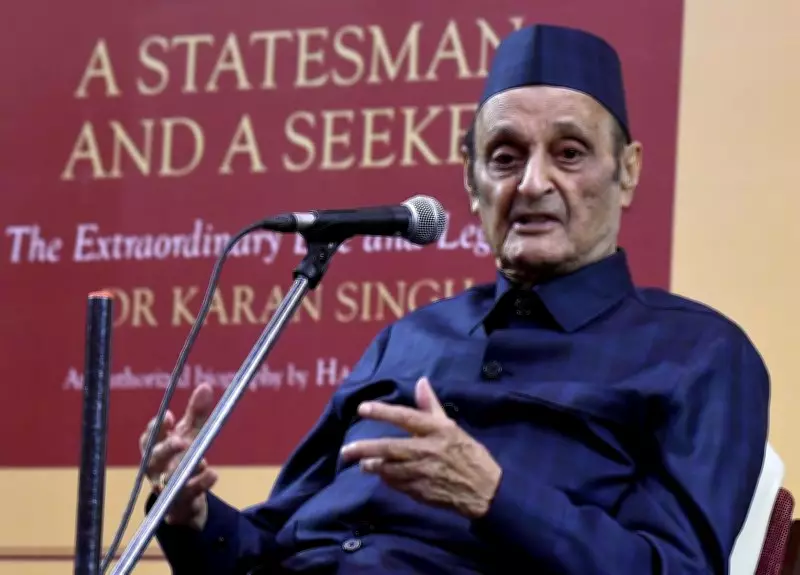
Karan Singh Draws Sharp Contrast Between Vedantic Hinduism and Hindutva
In a recent statement that has ignited widespread discussion, former Sadr-e-Riyasat of Jammu and Kashmir, Dr. Karan Singh, has publicly articulated a distinction between his personal interpretation of Hinduism and the political ideology of Hindutva. Singh, a prominent figure in Indian politics and culture, described his faith as rooted in the ancient, philosophical traditions of Vedanta, which he characterizes as inherently inclusive and universal. Conversely, he labeled Hindutva as an exclusionary framework that, in his view, diverges significantly from these broader spiritual principles.
The Core of Vedantic Philosophy: Inclusivity and Universality
Dr. Singh elaborated on his perspective by emphasizing the foundational tenets of Vedantic Hinduism. He explained that this school of thought, derived from the Vedas and Upanishads, promotes a non-dualistic understanding of reality, where the divine essence is seen as permeating all existence. This philosophical approach, he argued, naturally fosters tolerance, acceptance, and a sense of unity among diverse communities. Singh highlighted that Vedanta encourages introspection and spiritual growth rather than division, making it a unifying force in a pluralistic society like India.
Critique of Hindutva as an Exclusionary Ideology
In stark contrast, Singh critiqued Hindutva for what he perceives as its exclusionary nature. He suggested that while Hinduism as a religion encompasses a vast spectrum of beliefs and practices, Hindutva often manifests as a political ideology that prioritizes a particular cultural and religious identity, potentially marginalizing other groups. Singh expressed concern that this approach could undermine India's secular fabric and historical tradition of religious coexistence. His comments come at a time when debates around national identity and religious nationalism are increasingly prominent in public discourse.

Historical and Political Context of Singh's Remarks
Karan Singh's background adds significant weight to his statements. As the son of the last ruling Maharaja of Jammu and Kashmir and a former head of state, he has been a key figure in India's political landscape for decades. His views reflect a longstanding engagement with issues of governance, secularism, and cultural heritage. Singh has previously advocated for interfaith dialogue and a composite national identity, aligning with his vision of an inclusive Hinduism. This latest intervention is seen as part of his ongoing effort to shape conversations about religion and politics in contemporary India.
Reactions and Implications for Broader Discourse
The remarks have elicited varied responses from different quarters. Supporters applaud Singh for championing a more open and philosophical interpretation of Hinduism, while critics argue that his characterization of Hindutva may oversimplify a complex ideological movement. The discussion touches on deeper questions about how religious traditions are interpreted and politicized in modern contexts. As India continues to navigate its diverse social landscape, voices like Singh's contribute to a critical examination of the intersections between faith, identity, and public life.
In summary, Karan Singh's delineation between Vedantic Hinduism and Hindutva underscores a significant ideological rift within discussions of Indian religiosity. By advocating for an inclusive, spiritually grounded approach, he challenges narratives that emphasize exclusivity, prompting further reflection on the role of religion in shaping national cohesion and cultural harmony.