

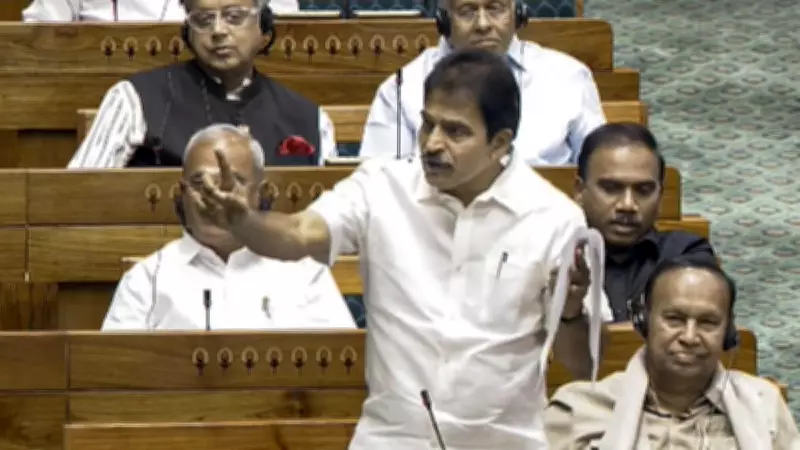
Congress Leader Accuses PM Modi of Unethical Conduct in National Address
In a significant political development, senior Congress leader KC Venugopal has formally submitted a breach of privilege notice against Prime Minister Narendra Modi to Lok Sabha Speaker Om Birla. The notice centers on the Prime Minister's recent address to the nation, which has sparked controversy and drawn sharp criticism from the Opposition.
Allegations of Unprecedented and Unethical Behavior
In his detailed letter to Speaker Om Birla, Venugopal has leveled serious accusations against the Prime Minister, describing his conduct as "unprecedented," "unethical," and a "blatant misuse of power." The Congress leader's complaint specifically targets Modi's criticism of the Opposition for the government's failure to secure a two-third majority necessary to pass the Constitution (131st Amendment) Bill, 2026.
Venugopal argued that the Prime Minister's remarks during the national address were not only inappropriate but also violated parliamentary norms and privileges. He emphasized that such public criticism undermines the dignity of the parliamentary process and sets a dangerous precedent for future political discourse.

Context of the Constitution Amendment Bill
The controversy stems from the government's inability to muster the required two-third majority in Parliament to pass the Constitution (131st Amendment) Bill, 2026. This legislative hurdle has become a focal point of political tension, with the ruling party and the Opposition locked in a heated debate over the bill's provisions and the government's strategy.
In his address, Prime Minister Modi reportedly blamed the Opposition for obstructing the bill's passage, accusing them of putting partisan interests above national welfare. This assertion has been met with strong rebuttals from Congress and other opposition parties, who argue that the government's failure to build consensus reflects its own shortcomings.
Implications for Parliamentary Democracy
Venugopal's breach of privilege notice raises critical questions about the boundaries of executive conduct and the sanctity of parliamentary proceedings. By taking this step, the Congress leader aims to hold the Prime Minister accountable for what he perceives as an overreach of power and a deviation from established democratic norms.
The notice calls for Speaker Om Birla to investigate the matter and take appropriate action to uphold the privileges of Parliament and its members. This move is seen as part of a broader opposition strategy to challenge the government's narrative and assert the role of constructive criticism in a healthy democracy.
Political Reactions and Future Developments
The submission of the privilege notice has ignited a fresh wave of political debate, with supporters of the government defending the Prime Minister's right to address the nation on key issues, while opposition figures rally behind Venugopal's stance. As the Speaker reviews the complaint, all eyes are on how this procedural matter will unfold and what impact it might have on the ongoing legislative session.
This incident underscores the deepening rift between the ruling party and the Opposition, particularly in the context of major legislative battles like the Constitution Amendment Bill. It also highlights the evolving dynamics of Indian politics, where procedural tools like privilege notices are increasingly used as instruments of political contestation.
The outcome of this notice could set important precedents for how similar disputes are handled in the future, potentially influencing the conduct of both the executive and the legislature in India's vibrant democracy.






