

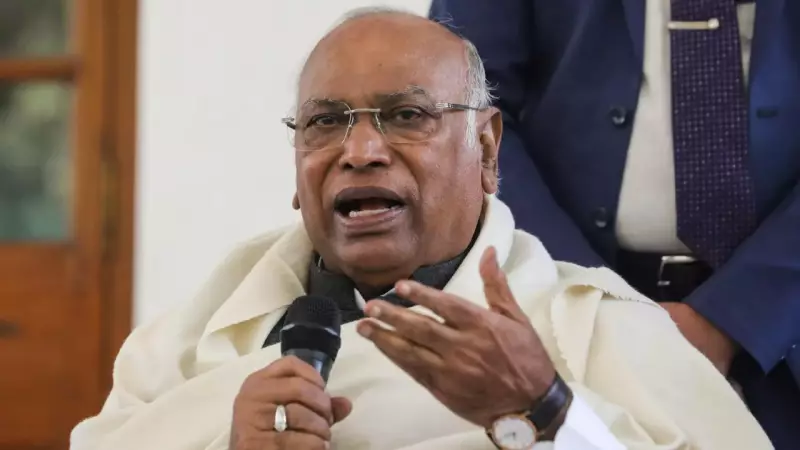
Congress President Mallikarjun Kharge on Friday launched a scathing critique of the Narendra Modi-led government's approach to international relations, labeling it inconsistent and detrimental to India's strategic interests. He pointed to two recent developments to substantiate his claims, questioning the government's commitment to national security and strategic autonomy.
Accusations Over Potential China Policy Shift
In a detailed post on social media platform X, Kharge highlighted reports suggesting the Centre is considering lifting restrictions imposed on Chinese companies from bidding for government contracts. These curbs were instituted five years ago in the aftermath of the deadly 2020 Galwan Valley clash between Indian and Chinese troops.
"The ban on Chinese companies, in place for five years, is being lifted," Kharge stated. He connected this potential move to a past controversy, recalling that the sacrifice of Indian soldiers in Galwan had been "insulted" when China was given a "clean chit." The Congress chief alleged that allowing these firms back into public tenders would be akin to rolling out a "red carpet" for them, directly challenging the government's stance on protecting national security.

As per reports from news agency Reuters, the government is contemplating rolling back rules that mandated companies from neighboring countries, including China, to undergo special registration and security clearances before participating in public procurement. This proposed relaxation is viewed as an effort to ease supply bottlenecks and revive stalled infrastructure projects, particularly in critical sectors like power. Any final decision on this matter would require approval from the Prime Minister's Office.
Silence on Trump's Remarks Questioned
Kharge's second major criticism focused on US President Donald Trump's repeated public comments regarding India's purchase of Russian oil. He accused Prime Minister Modi of maintaining silence despite Trump "commenting daily" on the issue, which he argued projected a weak image.
"Modi ji is averting his gaze. The 'sir' business looks more like surrender," Kharge remarked. The "sir" reference was a pointed jibe at recent remarks by Trump, where he recounted an incident involving India's wait for US defence equipment. Trump mentioned that India had ordered 68 Apache helicopters but faced a nearly five-year delay, prompting PM Modi to approach him. "Prime Minister Modi came to see me, 'Sir, may I see you please? Yes!'" Trump had said, linking the interaction to India's oil imports from Russia.
Kharge argued that this perceived lack of a firm response from New Delhi allowed India's position on continuing Russian oil imports to be publicly questioned without rebuttal.
Broader Critique of Strategic Autonomy
Beyond these specific instances, the Congress president presented a broader indictment of the government's foreign policy framework. He asserted that foreign policy must prioritize national interest above all other considerations.
Kharge claimed that the Modi government's approach has weakened India's long-standing commitment to non-alignment and strategic autonomy. "The Modi government's foreign policy swings like a wild pendulum — now this way, now that — and it is the people of India who are paying the price," he added, emphasizing the need for consistency in decisions with long-term implications.
These sharp remarks come at a time when India and China have been taking cautious steps to stabilize bilateral ties after years of border tensions. While some people-to-people exchanges, like direct flights, have resumed, core restrictions on Chinese foreign direct investment in India remain enforced. Kharge maintained that the apparent policy shifts reflect a fundamental lack of coherence, driven more by short-term pressures than a clear, nation-first strategy.






