

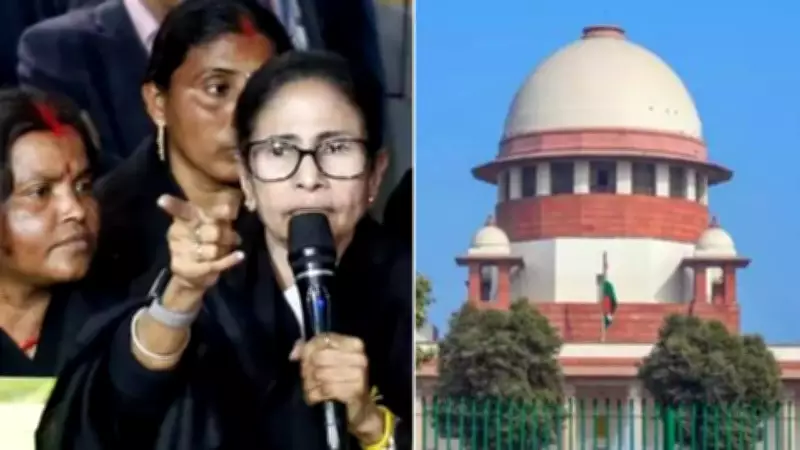
Mamata Banerjee Escalates Electoral Roll Dispute with Supreme Court Petition
West Bengal Chief Minister Mamata Banerjee's prolonged confrontation with the Election Commission of India over the Special Intensive Revision of electoral rolls reached a critical juncture on Wednesday as she personally approached the Supreme Court, seeking judicial intervention to "save democracy". The Trinamool Congress supremo filed a petition challenging the ongoing SIR exercise in her state, alleging systematic targeting and bulldozing of West Bengal's electorate through the revision process.
Chief Minister's Unprecedented Court Appearance
In a rare occurrence, a serving chief minister personally addressed the Supreme Court bench, with Banerjee arriving directly from the residence of her party colleague and nephew, Abhishek Banerjee. During the hearing, she passionately argued that West Bengal was being "singled out" while similar standards were not being applied in other states like Assam.
"West Bengal is being targeted," Banerjee told the bench headed by Chief Justice Surya Kant. "When justice is crying behind closed doors, it creates a feeling that justice is not being delivered anywhere. They are targeting West Bengal to bulldoze its people."

The chief minister revealed she had written six letters to the Election Commission without receiving satisfactory responses, compelling her to seek judicial relief. At the conclusion of her arguments, she thanked the bench for the opportunity to present her case and reiterated her appeal to "save democracy" from what she perceives as unfair electoral practices.
Legal Arguments and Electoral Concerns
Senior advocate Shyam Divan, representing Banerjee, presented alarming statistics to the court. With only four days remaining until the February 14 deadline for completion of the SIR exercise, he highlighted several critical issues:
- Approximately 32 lakh voters remain unmapped in the electoral database
- Around 1.36 crore names have been flagged under "logical discrepancies"
- Hearings are still pending for nearly 63 lakh cases
Divan explained that logical discrepancies encompass various technical issues including mismatches in parents' names and cases where the age gap between voters and their parents falls outside the 15-50 year range. He further alleged that valid documents such as domicile certificates, Aadhaar cards, and OBC certificates were being arbitrarily rejected, forcing voters to endure four to five hour queues for verification.
Banerjee herself raised additional concerns, stating that Aadhaar was not being accepted as valid identification and claiming that numerous living individuals had been incorrectly declared deceased during the revision process.
Supreme Court's Observations and Directions
The Supreme Court bench, comprising Chief Justice Surya Kant along with Justices Joymalya Bagchi and Vipul M Pancholi, acknowledged the unusual nature of a sitting chief minister personally arguing before the court. The bench emphasized that "genuine persons must remain on the electoral roll" and stressed that while electoral roll revision might involve migration-related issues, no innocent voter should be excluded.
"Every problem has a solution and we must ensure that no innocent person is left out," observed Chief Justice Kant. The court issued formal notices to the Election Commission and the Chief Electoral Officer of West Bengal, seeking their responses by February 9, and scheduled the next hearing for that date.
Election Commission's Counterarguments
Senior advocate Rakesh Dwivedi, appearing for the Election Commission, countered Banerjee's allegations by stating that the West Bengal government had provided only 80 grade-two officers such as Sub-Divisional Magistrates to oversee the SIR process. He claimed that the state administration had primarily supplied lower-ranked government employees like Anganwadi workers for the exercise.
Banerjee promptly rejected these charges, asserting that her government had extended whatever assistance the poll panel had requested for conducting the electoral roll revision.

Background of the Ongoing Dispute
This legal confrontation follows the Supreme Court's January 19 directions emphasizing transparency and convenience in the SIR process. The court had instructed the Election Commission to display lists of voters with logical discrepancies at gram panchayat bhavans and block offices while facilitating document submission and objections at these locations.
Banerjee has consistently criticized the EC's approach, warning that it could lead to "mass disenfranchisement" and "strike at the foundations of democracy." In a January 3 letter to Chief Election Commissioner Gyanesh Kumar, she described the process as "arbitrary and flawed" and accused the EC of presiding over an "unplanned, ill-prepared and ad hoc" exercise marked by serious irregularities and procedural violations.
Earlier this week, Banerjee traveled to Delhi to personally meet the CEC and press her objections. While sources indicated the meeting ended abruptly amid allegations of misbehavior, Banerjee claimed she was "humiliated" during the interaction.
Political Ramifications and Opposition Response
As part of her campaign against the SIR exercise, Banerjee has called for the impeachment of the chief election commissioner and sought support from other opposition parties. Congress leader K C Venugopal endorsed her impeachment call, stating that the opposition was "positively" considering moving a motion against the Chief Election Commissioner.
"I think the entire opposition will take a call on the matter. We are positively looking at it," Venugopal told mediapersons in the Parliament House complex. However, Leader of Opposition in the Lok Sabha Rahul Gandhi declined to comment on the issue, indicating varying responses within the opposition ranks.
The escalating conflict between West Bengal's ruling party and the Election Commission represents a significant constitutional and political challenge, with implications for electoral integrity and federal relations as the state prepares for future democratic exercises.





