Prime Minister Narendra Modi has brought the historical narrative of Gujarat's Somnath Temple back into the national spotlight, marking the upcoming 1000-year anniversary of its first major attack. In a significant statement, the PM linked the temple's enduring story to India's contemporary global ascent and its civilizational resilience.
The Prime Minister's Statement and a Millennial Marker
Ahead of his scheduled visit to the shrine on January 11, 2026 as part of the 'Somnath Swabhiman Parv' year-long commemoration, Modi reflected on the temple's legacy. He emphasized that the year 2026 marks a millennium since Sultan Mahmud of Ghazni's raid on Somnath in 1026 AD.
"The story of Somnath is not defined by destruction," the Prime Minister asserted. "It is defined by the unbreakable courage of crores of children of Bharat Mata." He positioned the temple as the ultimate example of India's indomitable spirit, standing gloriously despite centuries of struggle.

Modi further connected this historical endurance to modern-day achievements. "It is our value systems and the determination of our people that have made India the centre of global attention today," he stated, suggesting a direct lineage from ancient resilience to present-day optimism.
Somnath: A Central Pillar in Hindutva Historical Narrative
The Prime Minister's articulation taps into a long-standing theme within Hindutva discourse. For decades, ideologues have viewed Mahmud of Ghazni's invasion as the starting point of a 1000-year period of subjugation, contrasting with the secular historiography focus on 200 years of British rule.
This narrative frames the event not merely as a temple plunder for wealth, common in that era, but as a profound civilizational trauma inflicted by an iconoclast. Persian chronicles label Mahmud a 'but-shikan' or idol-breaker. The Sangh Parivar and its thinkers have consistently elevated Somnath as the symbolic beginning of a long era of resistance by figures like Chhatrapati Shivaji, Rana Pratap, and Guru Gobind Singh.
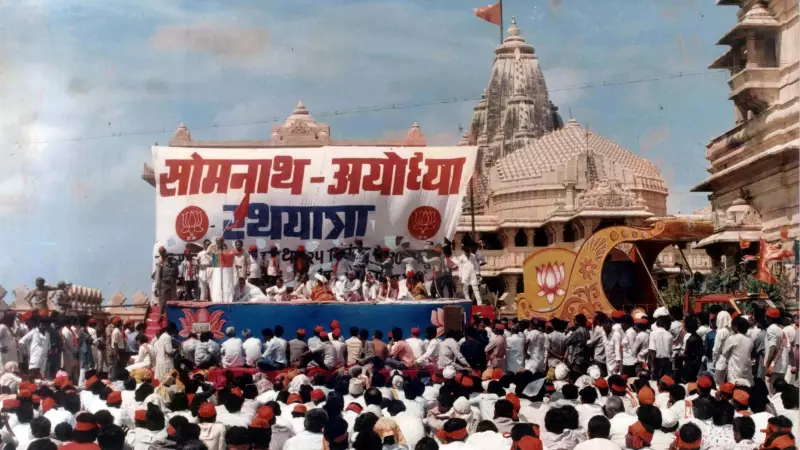
The temple's political utility for the Bharatiya Janata Party (BJP) is deeply etched. It was from Somnath that senior leader L K Advani launched his seminal Rath Yatra on September 25, 1990, bound for Ayodhya to champion the Ram Temple cause. This event catapulted Hindutva politics into the mainstream, transforming the BJP from a marginal force into a national contender.
Political Echoes: From Patel's Reconstruction to Nehru's Discomfort
The story of Somnath's revival in modern India also provides rich political symbolism for the Parivar. The reconstruction of the temple was championed by India's first Home Minister, Sardar Vallabhbhai Patel. Although he passed away before its completion, the project reflected his vision.
The consecration ceremony in May 1951 saw a notable clash of ideologies. Despite objections from then Prime Minister Jawaharlal Nehru, who believed official participation would project a poor image of India, the nation's first President, Dr. Rajendra Prasad, presided over the rituals. Modi explicitly referenced this incident, highlighting Nehru's reluctance and Prasad's firm stance.
This episode allows the Sangh Parivar to claim an ideological overlap with Patel's legacy while simultaneously critiquing Nehruvian secularism as disconnected from public sentiment.
The emotional weight of Somnath transcends hardline voices. Former Prime Minister Atal Bihari Vajpayee, often regarded as a moderate, shared a poignant anecdote in the 1980s. As External Affairs Minister, he visited Afghanistan and expressed a desire to see Ghazni. He described Ghazni as a "thorn in my flesh" since his youth, a place from where a plunderer came to loot the 'golden bird' that was India.
As India approaches this historical milestone, the Somnath Temple remains far more than an archaeological site. It is a powerful symbol, a political tool, and a foundational story, continually reinterpreted to speak to the nation's past struggles and its aspirational future.