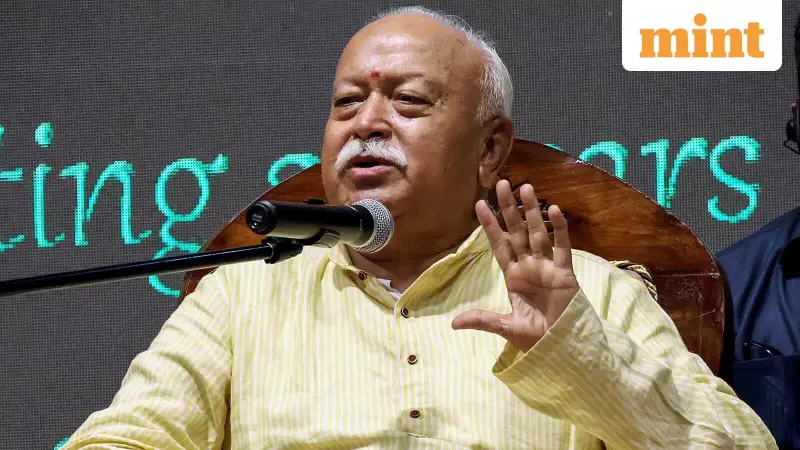
In a significant address that has captured national attention, Rashtriya Swayamsevak Sangh (RSS) chief Mohan Bhagwat has firmly responded to the ongoing debate surrounding the organization's official registration. Speaking on Sunday, Bhagwat dismissed the controversy, providing a historical and philosophical perspective on the matter.
Historical Context and the Registration Question
Mohan Bhagwat directly tackled the issue by framing it within India's historical timeline. He reminded the audience that the RSS was established in the year 1925, during the era of British rule. He posed a poignant rhetorical question to his listeners, asking, "Should we have registered RSS with the British government as it was established in 1925?" This question underscored the organization's origins in the pre-Independence struggle.
He further elaborated that after India gained its freedom, the Indian government did not make registration a compulsory requirement for organizations like the RSS. Bhagwat emphasized that despite the lack of a formal registration certificate, the Sangh is a fully recognized entity. "We are categorised as a body of individuals; we are a recognised organisation," he stated authoritatively.

The Philosophical Argument: Beyond Formal Registration
Expanding his argument beyond legalistic definitions, the RSS Sarsanghchalak made a profound cultural and philosophical comparison. He pointed out that many significant entities and concepts in Indian society operate without formal state registration. To drive his point home, he declared, "Many things are not registered. Even Hindu Dharma is not registered."
This statement equates the identity and existence of the RSS with that of the ancient and foundational principles of Hindu Dharma, suggesting that both derive their legitimacy from their pervasive presence and acceptance in society, rather than from a government-issued document. This analogy positions the organization as an intrinsic part of India's social and cultural fabric.
Implications and the Way Forward
By framing the debate in this manner, Mohan Bhagwat has effectively shifted the discourse from a legal technicality to a question of cultural and historical identity. His comments are likely to solidify the stance of the RSS and its supporters, portraying the registration controversy as an inconsequential administrative matter that fails to grasp the organization's true nature and contribution to the nation.
The address signals that the RSS will continue to operate with the conviction that its recognition comes from its work and its place in the national consciousness, not from any bureaucratic procedure. This perspective is set to define the organization's response to similar queries in the future.