

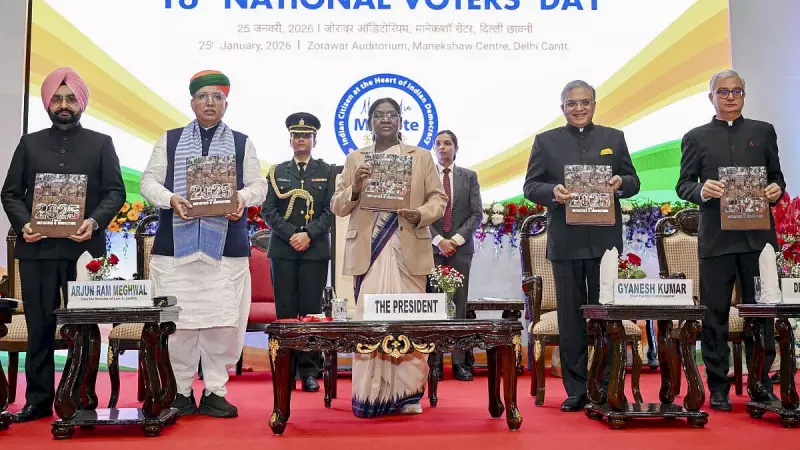
President Droupadi Murmu Calls for Prudent Voting, CEC Stresses Clean Electoral Foundation
In a significant address that resonates across the nation's political landscape, President Droupadi Murmu has issued a powerful appeal to Indian citizens, urging them to exercise wisdom and discernment while casting their votes. The President's message, delivered with gravitas, emphasized the critical importance of resisting external temptations and personal biases during the electoral process.
Murmu's Three-Pronged Appeal to Voters
President Murmu articulated a clear three-fold directive to voters that forms the bedrock of responsible citizenship in a democracy:
- Shun Allurement: The President cautioned citizens against falling prey to material inducements or short-term benefits that might compromise their voting decisions.
- Avoid Prejudice: Murmu emphasized the need to transcend personal biases, communal considerations, and preconceived notions when evaluating candidates and political platforms.
- Employ Wisdom: The core of her message centered on applying rational judgment, critical thinking, and long-term perspective while making electoral choices that shape the nation's future.
CEC Gyanesh Kumar on Electoral Integrity
Speaking on the same occasion, Chief Election Commissioner Gyanesh Kumar delivered complementary remarks that addressed the structural foundations of democratic processes. Kumar articulated a principle recognized by democracies worldwide: "A clean electoral roll is the cornerstone of a strong democracy."

The Election Commission's commitment to maintaining accurate, transparent, and inclusive voter lists represents a fundamental safeguard against electoral malpractices. Kumar's statement underscores the institutional mechanisms that support the individual responsibility emphasized by President Murmu.
The Symbiosis of Individual and Institutional Responsibility
These parallel messages create a comprehensive framework for democratic participation. While President Murmu focuses on the ethical and intellectual dimensions of voter behavior, CEC Kumar highlights the administrative and procedural integrity that enables fair elections.
This dual emphasis reflects India's maturing democratic discourse, where citizen awareness and institutional robustness are increasingly recognized as mutually reinforcing elements. The timing of these statements, as the nation prepares for future electoral cycles, adds particular significance to their content.
Broader Implications for Indian Democracy
The convergence of messages from the highest constitutional office and the election regulatory body sends a powerful signal about the priorities for India's democratic health. It acknowledges that:
- Voter education and ethical awareness are as crucial as electoral logistics
- Democracy's strength derives from both individual choices and systemic safeguards
- The quality of electoral participation directly impacts governance outcomes
As India continues to navigate complex political landscapes, such guidance from constitutional authorities provides valuable orientation for citizens and institutions alike. The emphasis on wisdom over impulse, principle over convenience, and transparency over opacity represents a maturation of democratic values in practice.






