Nagpur District Election Office Launches Comprehensive Voter Roll Cleanup Drive
The district election office in Nagpur has officially launched a comprehensive voter mapping, verification, photo correction, and deletion initiative targeting duplicate or deceased names from electoral rolls. This extensive exercise is being conducted in strict adherence to the directives issued by the Election Commission of India, ahead of the upcoming Special Intensive Revision (SIR).
Strict Deadline Set for Booth-Level Officers
On Tuesday, the district collector established a rigorous 10-day deadline for all booth-level officers (BLOs) to complete this critical voter roll cleanup. The officers must finalize the exercise by March 28 and are required to submit daily progress reports to ensure accountability and timely completion. This move underscores the urgency and importance of maintaining accurate and up-to-date voter databases.
Current Voter Statistics and Timeline
As of October 15, 2024, Nagpur district boasts a total of 44,94,787 registered voters. This figure includes 21,28,789 voters in urban areas and 23,65,998 in rural regions. While the Special Intensive Revision is scheduled to commence in April, the voter mapping process has been actively underway for over a month, indicating a proactive approach to electoral management.

Concerns Over Public Awareness and Exclusion Risks
The lack of a formal public announcement and limited awareness among citizens have raised significant concerns regarding the potential exclusion of eligible voters or a last-minute rush for necessary documentation. Under this exercise, voters are mandated to submit details from the 2002 electoral rolls along with their EPIC number based on the 2024 rolls. Individuals not listed in the 2002 rolls must provide proof of identity or any of the 13 documents prescribed by the Election Commission of India.
Door-to-Door Verification to Follow Mapping
Once the initial mapping phase is completed, a thorough door-to-door verification drive will be implemented. Deputy district election officer Rachana Indurkar highlighted that progress has been uneven across the district, ranging from 15% to 60%, which contrasts sharply with the 80–90% completion rates observed in other districts. She emphasized the critical need to accelerate fieldwork to meet the established deadlines.
Validation and Removal of Ineligible Entries
Indurkar clarified that after the official rollout in April, the survey will rigorously validate eligible voters and systematically remove ineligible entries from the electoral rolls. This step is crucial for ensuring the integrity and accuracy of the voter list, thereby preventing electoral fraud and discrepancies.
Preparedness and Training Challenges
Concerns have been raised regarding the overall preparedness for this extensive exercise. Corporator Wasim Khan pointed out that inadequate training and low public awareness have resulted in poor cooperation from citizens and inconsistent fieldwork. He announced plans to organize awareness camps to improve participation and alleged that some BLOs were not taking the process seriously, displaying unfamiliarity with both the procedure and the associated application.
Former standing committee chairman Pintu Vijay Zalke noted that the exercise has yet to be formally announced and is likely to gain significant momentum only in April, potentially delaying comprehensive implementation.
Official Training and BLO Reluctance
In response, Indurkar maintained that comprehensive training sessions have been conducted. Assistant returning officers received training in Madhya Pradesh, while BLOs were trained locally. However, she acknowledged that reluctance among BLOs, many of whom are teachers, has considerably slowed progress. To address these challenges, the chief electoral officer is scheduled to visit on Wednesday to review the exercise and expedite its completion.

Special Intensive Revision: Key Operational Details
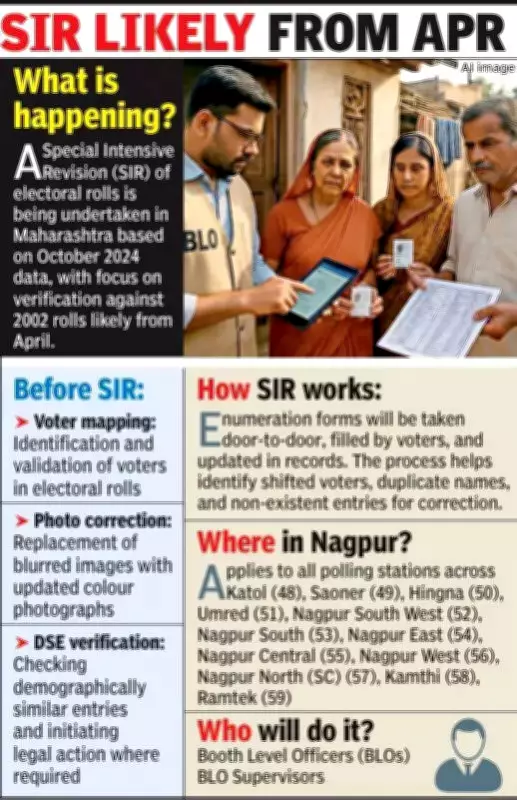
The Special Intensive Revision (SIR) of electoral rolls in Maharashtra is based on October 2024 data, with a primary focus on verification against the 2002 rolls, likely commencing in April. Prior to the SIR, the voter mapping process involves identification and validation of voters in electoral rolls, photo correction through replacement of blurred images with updated color photographs, and DSE verification to check demographically similar entries and initiate legal action where required.
During the SIR, enumeration forms will be taken door-to-door, filled by voters, and updated in official records. This meticulous process helps identify shifted voters, duplicate names, and non-existent entries for necessary corrections.
Geographical Scope and Implementation Team
This exercise applies to all polling stations across multiple constituencies in Nagpur, including Katol (48), Saoner (49), Hingna (50), Umred (51), Nagpur South West (52), Nagpur South (53), Nagpur East (54), Nagpur Central (55), Nagpur West (56), Nagpur North (SC) (57), Kamthi (58), and Ramtek (59). The implementation will be carried out by Booth Level Officers (BLOs) and BLO Supervisors, ensuring grassroots-level execution.
Mapping Timeline and Future Steps
The voter mapping timeline is strictly set from March 18 to March 28, 2026, providing a clear framework for completion. This initiative represents a significant step towards enhancing electoral transparency and accuracy in Nagpur, addressing long-standing issues of voter list discrepancies and ensuring a fair electoral process for all eligible citizens.