

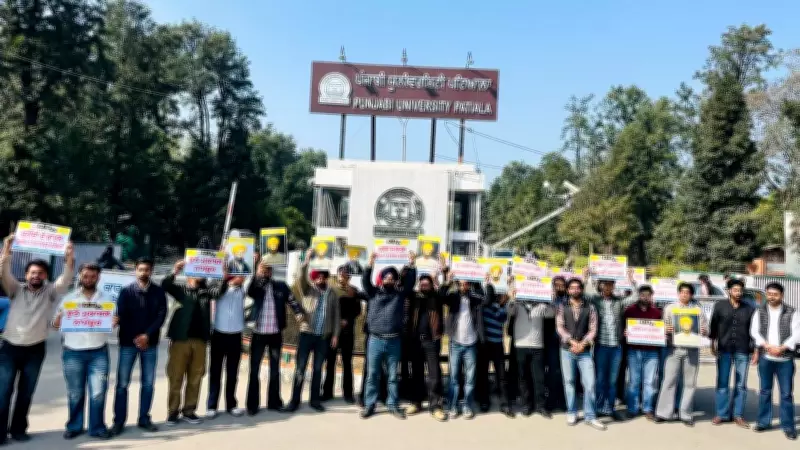
Four Decades of Unresolved Grief: Nakodar Firing Families' Final Plea for Justice
Four decades after the tragic 'Saka Nakodar' police firing incident, the families of four young Sikh men gathered at Sri Akal Takht Sahib in Amritsar on Wednesday, marking the 40th anniversary with a solemn yet determined appeal for justice. The victims—Ravinder Singh, Baldhir Singh, Jhilman Singh, and Harminder Singh—were remembered as "sons of the Khalsa Punjab" who sacrificed their lives while protesting the sacrilege of the Guru Granth Sahib on February 4, 1986, in Nakodar, Jalandhar district.
A Legacy of Institutional Failure and Unanswered Questions
The families offered prayers for the slain students and vehemently criticized successive state governments for what they describe as a complete failure to deliver justice despite repeated assurances at the highest levels. Baldev Singh, father of Ravinder Singh and a central figure in the decades-long campaign, expressed his anguish over "four decades of silence, delay and injustice." He emphasized that while age may be against him, his commitment to securing justice remains unwavering, and he now plans to approach international forums as domestic avenues have proven futile.
The incident, where unarmed students were shot dead by police during sacrilege-related protests, bears a chilling resemblance to the 2015 Behbal Kalan firing in Faridkot, where two Sikhs were killed under similar circumstances. Following the Nakodar tragedy, then-Punjab Chief Minister Surjit Singh Barnala ordered a judicial inquiry led by retired Punjab and Haryana High Court judge Justice Gurnam Singh. The panel's report, submitted on October 31, 1986, highlighted numerous contradictions in the police's version of events and confirmed that all victims were shot at close range in their upper bodies, with Harminder Singh being shot in the mouth.

From Democratic Doors to International Forums: A Shift in Strategy
Over the past 40 years, the families have knocked on every "democratic door"—from chief ministers and state governments to courts, Governors, and even Presidents—yet the state has failed to ensure even basic accountability for the killings. In a joint statement, the families lamented that "their blood was spilled in broad daylight, and yet the truth has been buried under layers of bureaucracy, political hesitation and institutional indifference." They stressed that their struggle has always been peaceful, lawful, and rooted in faith in democratic institutions, seeking not revenge but "truth, recognition, and a transparent, time-bound judicial process."
Describing this 40th anniversary as their "final appeal," the families clarified that their pain has not lessened but that four decades is too long for any democracy to deny justice to bereaved parents and siblings. They warned that history will judge whether the present government demonstrates the courage to act or allows another generation to inherit "unresolved grief." Far from fading, the memory of the four men has "hardened into resolve," prompting a strategic shift toward international platforms in pursuit of justice.
Broader Context and Continuing Struggles
The Nakodar firing is part of a broader pattern of sacrilege-related protests and state responses in Punjab, reflecting ongoing tensions between religious sentiments and law enforcement. The families' appeal comes at a time when similar issues, such as the Behbal Kalan firing, remain unresolved, highlighting systemic challenges in addressing historical injustices. Their move to international forums underscores growing disillusionment with domestic mechanisms and a desire for global scrutiny of human rights violations.
As the families prepare to take their fight beyond India's borders, their story serves as a poignant reminder of the enduring quest for accountability in cases of state violence. The 40th anniversary not only commemorates the lives lost but also reignites calls for transparency and justice in a democracy that must confront its past to build a more equitable future.






