Namesake Candidates Proliferate in Tamil Nadu Assembly Elections
In a striking electoral phenomenon, the 2026 Tamil Nadu assembly elections have witnessed a surge of namesake candidates across more than 100 constituencies, deliberately mirroring the names of prominent contenders to sow confusion among voters. This tactic, which political insiders describe as a strategic move by opponents, has resurfaced with significant intensity, complicating the democratic process in key battlegrounds.
Multiple Identities in Key Constituencies
In the Coimbatore South assembly constituency, five individuals named Senthil Kumar are in the fray. Among them, one is the official candidate of the Tamil Nadu Vanniyar Katchi (TVK), while the remaining four are independents. Notably, this constituency also features former DMK minister V Senthil Balaji as a contestant, adding to the electoral complexity.
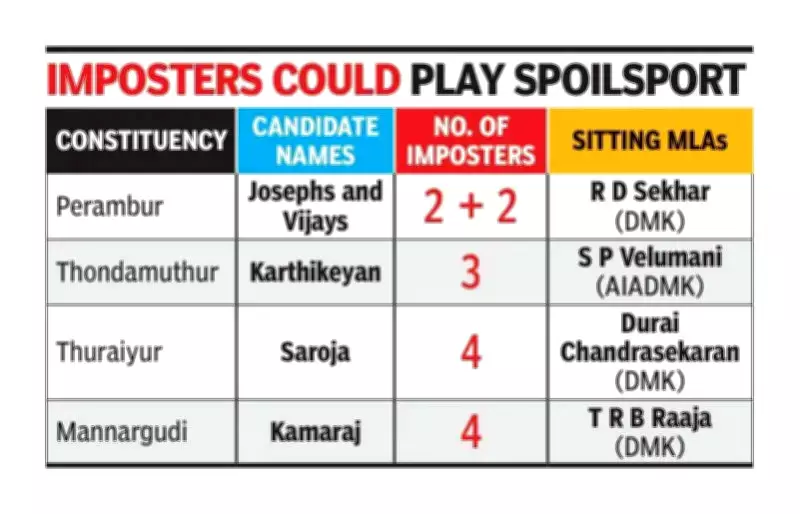
Similarly, in Perambur, where TVK president Vijay is contesting, voters face two additional candidates named Vijay and two named Joseph, blurring lines of identification. The pattern extends to Thondamuthur, where AIADMK's S P Velumani is pitted against three Karthikeyans, echoing the name of DMK's official candidate N Karthikeyan.

In Thurayur assembly segment within Trichy district, AIADMK has fielded Saroja, but three more candidates share her name, while Mannargudi boasts four Kamarajs, potentially bewildering NDA supporters. Party members assert this is no coincidence but a calculated effort to mislead voters, particularly in tight races.
Historical Impact and Electoral Consequences
The strategy has proven impactful in previous close contests. For instance, in the 2021 Katpadi election, where Duraimurugan secured victory by a mere 700 votes, three namesakes of AIADMK candidate Ramu were present. Independent candidates K Ramu and D Ramu garnered 350 and 99 votes respectively, while another candidate named Raman received 144 votes, highlighting how such tactics can sway outcomes in marginal seats.
Election Commission's Countermeasures
In response to this growing issue, the Election Commission (EC) has implemented a new measure for the 2026 polls: adding candidate photographs on Electronic Voting Machines (EVMs) alongside party symbols. This initiative aims to reduce voter confusion by providing visual identification, though its effectiveness remains under scrutiny.
Expert and Political Perspectives
Psephologist R Chandrasekaran noted that courts have recognized the severity of this practice, with the Kerala High Court labeling it a 'massacre of democracy' and warning that namesake candidates are deployed to deceive voters. However, he emphasized that enforcement remains weak, allowing the manipulation to persist due to limited intervention.
TVK functionary T Selvakumaran expressed skepticism about the EC's new measure, stating, "Photographs may help but are not enough. For a party like TVK with many new faces, voters are not familiar with candidates, so the symbol becomes key. But even symbols create confusion — free symbols like hand rollers resemble our whistle. Such tactics must be acted against by the EC."
Broader Implications for Democracy
The recurrence of namesake candidates underscores broader challenges in electoral integrity, raising questions about the adequacy of current regulations. As Tamil Nadu navigates this electoral landscape, the effectiveness of the EC's photograph addition will be closely monitored, with stakeholders calling for stronger actions to curb deceptive practices and ensure fair voting processes.