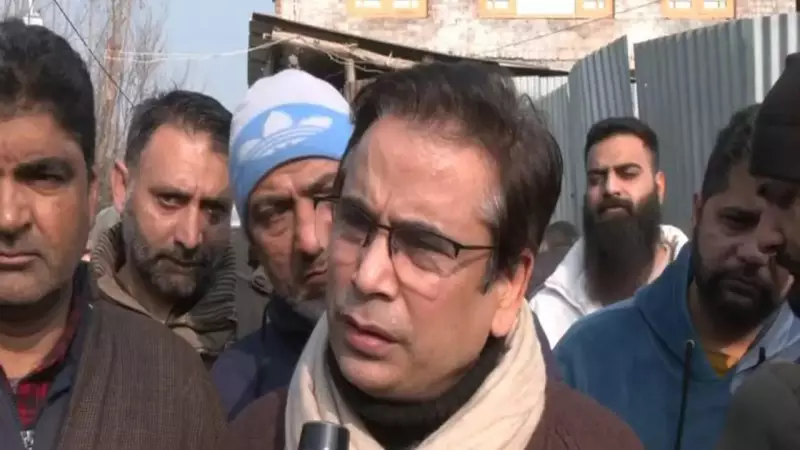
National Conference legislator and chief party spokesperson Tanvir Sadiq has formally submitted a resolution in the Jammu and Kashmir Legislative Assembly. He seeks a thorough review of the recent decision by the National Medical Council to withdraw permission from the Shri Mata Vaishno Devi Institute of Medical Excellence to run its MBBS course.
Resolution Calls for Fair Assessment
According to party sources, Sadiq's private member's resolution strongly urges the central government and the NMC to reconsider their move. The resolution clearly states that no educational institution should ever face denial of approval based solely on the religion of its enrolled students.
Insiders from the National Conference reveal the resolution aims to convey the collective sense of the House. It expresses deep concern over the NMC's decision to revoke permission merely four months after granting initial approval for the MBBS program at SMVDIME.

Substantial Public Investment at Stake
The resolution calls for a completely fair and impartial assessment of the entire issue. It highlights that the Shri Mata Vaishno Devi Institute of Medical Excellence was specifically established to address the critical healthcare and medical education needs of Jammu and Kashmir.
This institution was developed with significant public funding and substantial infrastructure support. The governing party fully expects this resolution to pass with a strong majority vote when presented before the Assembly.
Background of the Legislator and Session
Tanvir Sadiq serves as a close aide to Chief Minister Omar Abdullah and previously acted as his political adviser. He is also widely recognized as the Chief Minister's regular marathon-running companion. The Assembly's 27-day session is scheduled to commence on February 2, beginning with the Lieutenant Governor's formal address to the House.
NMC's Decision and Immediate Fallout
On January 6, the National Medical Council officially withdrew permission for the college to admit 50 MBBS students for the 2025–26 academic year. This batch would have been the institute's very first cohort of medical students.
The council cited major deficiencies in faculty availability, clinical material, and overall infrastructure as primary reasons for its action. The NMC further stated that students already admitted during counselling for the 2025–26 session would receive accommodation in other government medical colleges across the Union Territory.
Chief Minister's Strong Reaction
Chief Minister Omar Abdullah reacted strongly to the NMC's decision. On January 7, he publicly stated that while people across the entire country agitate and struggle to secure a medical college in their local areas, a medical college in Jammu faced shutdown following protests grounded in religious arguments.
He described the council's decision as completely unprecedented and deeply troubling for the region's educational landscape.
Origins of the Controversy
The controversy first erupted in November last year. This occurred after the college admitted its students strictly on the basis of NEET merit, following standard national procedure.
Out of the 50 available seats, the institute allotted 42 to Muslim students, with most hailing from Kashmir, along with one Sikh candidate. Only eight Hindu students from Jammu received selection.
Protests and Political Alignments
This admission outcome triggered immediate protests by the Jammu-based Sangharsh Samiti. This coalition consists of approximately 60 religious and civil society groups. It receives active support from the Vishva Hindu Parishad and the Bajrang Dal.
The protesting groups argued that an institution funded by the Shri Mata Vaishno Devi Shrine Board should logically give preference to Hindu students. They specifically stated preference should go to those who maintain faith in Mata Vaishno Devi.
The Bharatiya Janata Party also sided openly with the protesters. BJP leader Sunil Sharma submitted a formal memorandum to Lieutenant Governor Manoj Sinha, who heads the shrine board. The memorandum sought an urgent review of the admission policy.
It argued that "astha" or faith in Shri Mata Vaishno Devi should become a legitimate criteria for admission to a college that operates on donations primarily from the Hindu community.