In a significant statement issued from her residence in Germany on the eve of her father's 129th birth anniversary, Anita Bose Pfaff, the daughter of Netaji Subhas Chandra Bose, has unequivocally confirmed that the iconic freedom fighter died in a plane crash in Taipei in August 1945. She has passionately called for his mortal remains to be repatriated to India, thereby concluding what she describes as an "exile which he never desired."
Family Acceptance of the Plane Crash Theory
While certain factions within the Bose family historically contested the plane crash narrative, they have subsequently embraced it, particularly following the declassification of the 'Netaji files' in 2016. Chandra Bose, a grandnephew of Netaji, elaborated on this shift in perspective, noting that the family now acknowledges the crash as the definitive explanation for Netaji's disappearance.
"It is now amply clear he died in the crash as all the files point to it," Chandra Bose asserted. "There have so far been 11 inquiries, 10 of which concluded with the plane crash theory. There is no rational basis to dispute it, and Anita Bose Pfaff's recent statement powerfully reinforces that viewpoint. Although she never opposed the theory, she has perhaps never articulated it with such clarity before."

Detailed Account of the Fateful Flight
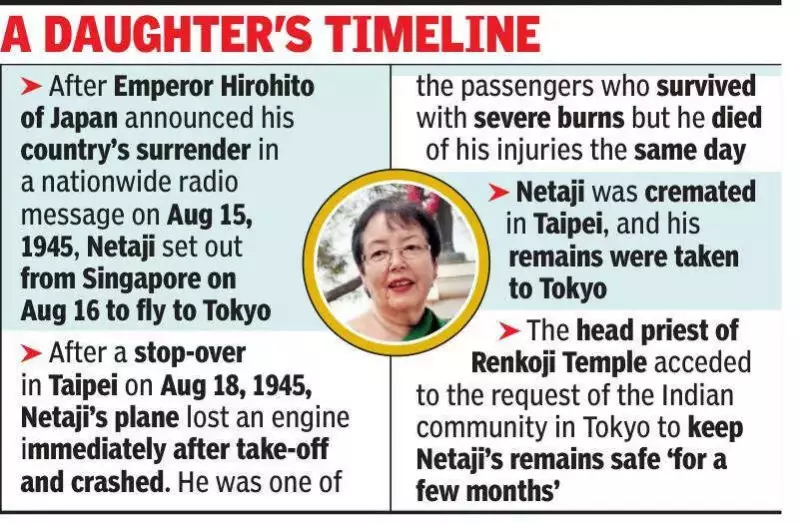
Bose Pfaff meticulously recounted the events leading to her father's tragic demise. As Japan faced defeat in World War II, Netaji embarked on a flight from Singapore to Tokyo on August 16, 1945. The aircraft made a stopover in Taipei on August 18, 1945, where it encountered catastrophic engine failure immediately after takeoff, resulting in a devastating crash.
"He was one of the passengers who survived with severe burns, but he succumbed to his injuries that same day," she wrote, providing a poignant and detailed narrative of the incident that has been the subject of extensive speculation and debate for decades.
The Journey of Netaji's Remains
Following his death, Netaji was cremated in Taipei, and his ashes were subsequently transported to Tokyo. At the request of the Indian community in Tokyo, the head priest of the Renkoji Temple agreed to safeguard Netaji's remains temporarily, intended for just "a few months."
Remarkably, over eight decades later, Netaji's ashes continue to reside at the Renkoji Temple. Bose Pfaff expressed profound gratitude to Japan and specifically to three successive generations of head priests at the temple for their diligent preservation and reverence of her father's remains.
Netaji's Aversion to Exile
Bose Pfaff highlighted her father's deep-seated aversion to exile, recalling that when asked about his greatest fears, Netaji reportedly responded, "to be in exile." In the 1930s, he courageously returned to India from exile in Europe, despite warnings of immediate imprisonment upon arrival. He later fled India in 1941 to evade renewed incarceration, tragically never returning alive to his beloved homeland.
A Daughter's Heartfelt Appeal
Concluding her emotional statement, Bose Pfaff made a heartfelt appeal to the Indian populace. "As Netaji's daughter, I invite the Indians of today who still revere him, to support his posthumous return from exile; to support the transfer of his mortal remains to India for a final and fitting disposal. Jai Hind," she declared, echoing the patriotic sentiment that defined her father's life and legacy.
This statement not only reaffirms the historical consensus regarding Netaji's death but also reignites the long-standing discourse on bringing his remains back to India, a move that would symbolically end his prolonged exile and honor his enduring legacy in the nation he fought so passionately to liberate.