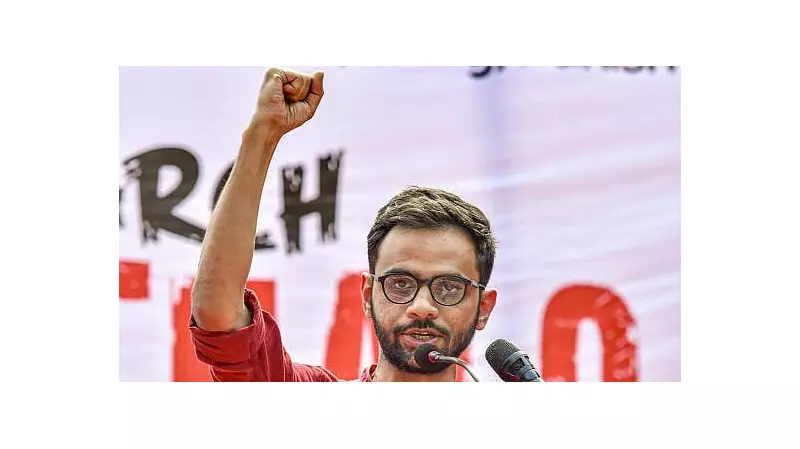
Opposition parties have launched a sharp critique of the Indian judicial system, highlighting what they call a stark contrast in its application of the law. Their criticism follows a Delhi court's decision to deny bail to former JNU student leader Umar Khalid in a case related to the 2020 northeast Delhi riots, while controversial Dera Sacha Sauda chief Gurmeet Ram Rahim Singh continues to receive parole extensions.
Court Denies Bail to Umar Khalid Under UAPA
A Delhi court, presided over by Additional Sessions Judge Sameer Bajpai, rejected the bail plea of Umar Khalid on May 28, 2024. Khalid has been incarcerated since September 2020 under the stringent Unlawful Activities (Prevention) Act (UAPA). The case against him is connected to the larger conspiracy allegations surrounding the communal violence that erupted in northeast Delhi in February 2020.
The court's order stated that the allegations against Khalid were "prima facie true" and that the provisions of the UAPA were correctly invoked. This marked another setback for Khalid, whose previous bail applications had also been denied by both the trial court and the Delhi High Court. His legal team has consistently argued that the evidence against him is circumstantial and based on doctored videos.

Political Outcry Over "Selective Justice"
The decision prompted immediate and fierce condemnation from a united opposition front. Leaders from the Congress, CPI(M), and other parties juxtaposed Khalid's continued detention with the regular parole granted to Gurmeet Ram Rahim Singh.
Ram Rahim is currently serving a 20-year sentence for the rape of two female disciples and a life term for the murder of a journalist. He has been released on parole multiple times, with his most recent furlough extended by the Punjab and Haryana High Court until June 17.
Congress leader Rahul Gandhi led the charge, stating that the contrast reveals the BJP government's misuse of investigative agencies to target political dissenters while being lenient towards those who support the ruling party. CPI(M) general secretary Sitaram Yechury echoed this sentiment, calling the situation a "travesty of justice" that exposes the government's double standards.
Legal Framework and Allegations of Bias
The opposition's argument hinges on the perceived differential treatment under two key legal areas: the UAPA and parole guidelines. The UAPA, with its strict bail conditions, has been criticized for being used against activists and dissenters. In contrast, parole provisions, intended for reform and humanitarian reasons, are seen as being generously applied to a convicted figure like Ram Rahim.
Shiv Sena (UBT) leader Priyanka Chaturvedi pointedly questioned the system, asking why a student leader remains behind bars without conviction while a convicted rapist and murderer enjoys frequent parole. This sentiment was widely shared across opposition platforms, framing the issue as one of political vendetta versus political patronage.
Government and Legal Defenses
In response, BJP leaders and government supporters have defended the court's independence. They argue that the bail denial to Khalid is a purely legal decision based on the gravity of the charges and the evidence presented by the Special Cell of the Delhi Police.
Regarding Gurmeet Ram Rahim's parole, officials from the Haryana government have stated that all releases have followed due procedure and legal advice. They maintain that parole is a statutory right, and each application is considered based on its own merits within the framework of the law.
However, this defense has done little to quell the political storm. The opposition has vowed to keep the issue alive, promising to raise it in Parliament and public forums as a prime example of the erosion of judicial fairness and constitutional values.
The simultaneous narratives of Umar Khalid's bail denial and Gurmeet Ram Rahim's parole have converged into a potent political controversy. It goes beyond individual cases to spark a heated national debate on the equality of law, the use of stringent statutes, and the perceived alignment of legal outcomes with political currents in India.