

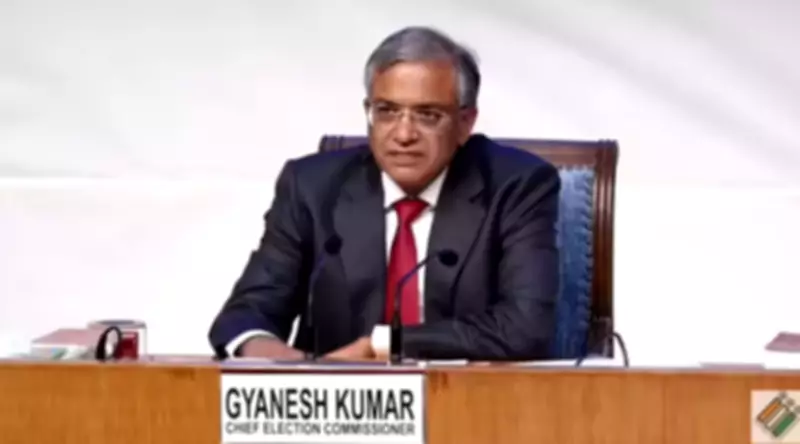
Opposition Coalition Files Historic Notice to Remove Chief Election Commissioner
In an unprecedented political maneuver, the Opposition has mobilized a significant parliamentary force to challenge the leadership of the Chief Election Commissioner (CEC). With a total of 130 Lok Sabha Members of Parliament and 63 Rajya Sabha MPs formally signing the notice, the coalition is poised to submit this document through the secretariat of one of the two Houses of Parliament on Friday. This marks the first instance in India's electoral history where such a notice has been initiated against a sitting CEC.
Parliamentary Procedure and Signature Collection
According to established parliamentary rules, a minimum of 100 MPs must endorse a notice seeking the removal of the CEC in the Lok Sabha, while the Rajya Sabha requires at least 50 signatures. The Opposition has far exceeded these thresholds, demonstrating substantial cross-party support. An Opposition leader revealed that the collection process continued actively until Thursday afternoon, with MPs steadily adding their signatures. By approximately 1:30 PM, the tally had reached 130 in the Lok Sabha and 63 in the Rajya Sabha.
All parties within the INDIA bloc have united in this effort, alongside MPs from the Aam Aadmi Party (AAP), which operates independently of the bloc. This broad-based support underscores the gravity of the allegations and the collective resolve to address perceived institutional biases.

Allegations and Charges Against the CEC
The notice, spearheaded by the Trinamool Congress (TMC), outlines nearly half a dozen serious charges against CEC Gyanesh Kumar. These allegations range from partisan conduct to accusations of mass disenfranchisement. Opposition parties have consistently accused Kumar of bias, particularly in his handling of the ongoing Special Intensive Revision (SIR) exercise, which they claim has been executed arbitrarily to benefit the Bharatiya Janata Party (BJP).
West Bengal Chief Minister Mamata Banerjee has been at the forefront of protests against the SIR process in her state, while Congress leader Rahul Gandhi has championed the "vote chori" campaign, amplifying concerns over electoral integrity. The growing chorus of criticism highlights deep-seated apprehensions about the impartiality of the Election Commission under Kumar's stewardship.
Legal Framework and Political Implications
The procedure for removing a Chief Election Commissioner mirrors that of a Supreme Court judge, requiring grounds of "proven misbehaviour or incapacity." This legal threshold makes the removal process inherently challenging, especially given the political dynamics at play. With the BJP-led alliance commanding a majority in both Houses of Parliament, the notice is widely viewed as a symbolic gesture rather than a viable legislative action.
However, this move serves a crucial political purpose: it allows the Opposition to formally register a joint protest and draw public attention to their grievances. By consolidating support across party lines, the coalition aims to highlight issues of electoral fairness and institutional accountability, setting the stage for broader debates on democratic norms and governance.
As the notice submission unfolds, the focus will remain on how parliamentary authorities process this historic document and the subsequent discussions it may ignite within India's political landscape.






