

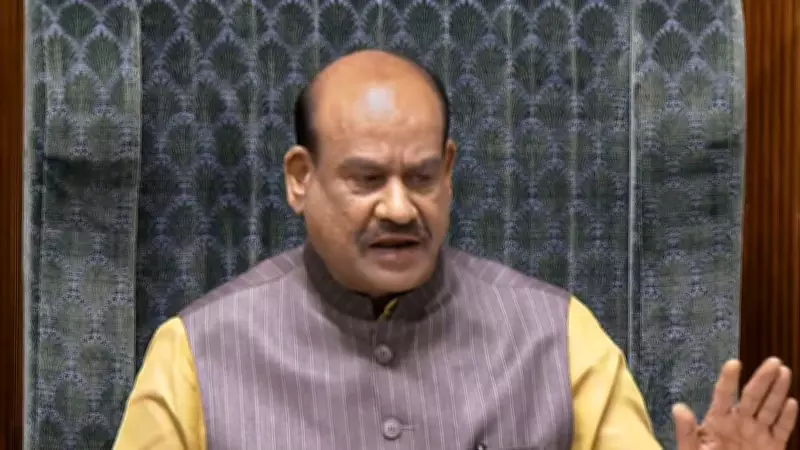
Opposition INDIA Bloc to Move No-Confidence Motion Against Lok Sabha Speaker Om Birla
In a significant escalation of parliamentary tensions, the INDIA bloc is set to move a no-confidence motion against Lok Sabha Speaker Om Birla. This move, which has garnered support from the Trinamool Congress (TMC), follows a series of confrontations between the Speaker and Opposition members, particularly over the handling of Leader of the Opposition Rahul Gandhi's speeches.
Background and Triggers
The decision to pursue a no-confidence motion stems from recent incidents in the Lok Sabha. On Thursday, the House passed the Motion of Thanks on the President's Address without Prime Minister Narendra Modi's speech. Speaker Birla informed the House that he had "credible information" suggesting some Congress MPs planned to create an "unprecedented incident" by approaching the Prime Minister's seat, leading him to request Modi's absence on Wednesday.
This statement, along with other developments, has become a focal point for the Opposition. An Opposition leader highlighted several charges discussed at a meeting on Monday:

- Rahul Gandhi was prevented from speaking while BJP MP Nishikant Dubey was allowed to make remarks deemed inappropriate.
- The Speaker's claim about potential threats to the Prime Minister in the House.
- Allegations against women MPs planning an attack on the Prime Minister.
Opposition Allegations of Bias
AICC general secretary (organisation) K C Venugopal described the recent proceedings as "very unfortunate," emphasizing that in a parliamentary democracy, the Leader of the Opposition should have a defined role. He stated, "In this Parliament, when the LoP stands up, the microphone is switched off. No Opposition member is allowed to speak. This Parliament has become one-sided and meant only for the ruling party."
Venugopal further questioned the Speaker's remarks about women MPs, asking for evidence to support the allegations. He asserted that the Speaker is expected to remain neutral, but current actions suggest otherwise.
Recent Clashes and Suspensions
Last week, the Lok Sabha witnessed repeated clashes, culminating in the suspension of eight Opposition MPs. Rahul Gandhi was stopped from quoting from former Army Chief General M M Naravane's unpublished memoir, leading to a boycott by the Opposition. Gandhi later wrote to Birla, arguing that he had followed instructions to authenticate the magazine report but was still prevented from speaking, violating a long-standing convention.
On Friday, Speaker Birla expressed frustration over the disruptions, noting that 19 hours and 13 minutes had been lost in the current session due to protests. He emphasized that Parliament is meant for raising issues, not shouting slogans.
Historical Context and Procedural Steps
This is not the first time the Opposition has considered a no-confidence motion against Birla. In March 2023, following Rahul Gandhi's disqualification as a Lok Sabha MP, the Congress contemplated such a move, though it did not materialize.
Under the Rules of Procedure and Conduct of Business in the Lok Sabha, a member seeking the removal of the Speaker must submit a written notice to the Secretary-General. A motion for leave to move such a resolution can only be listed after 14 days from receipt of the notice, on a day fixed by the Speaker. Historically, resolutions for the removal of the Speaker have been moved three times: against G V Malvankar in 1951, Sardar Hukam Singh in 1966, and Balram Jakhar in 1987.
What Comes Next
The INDIA bloc's move signals a deepening rift between the government and the Opposition. As tensions mount, the no-confidence motion could test parliamentary norms and the Speaker's impartiality. The outcome will depend on procedural adherence and political maneuvering in the coming days, potentially reshaping the dynamics of India's legislative proceedings.






