

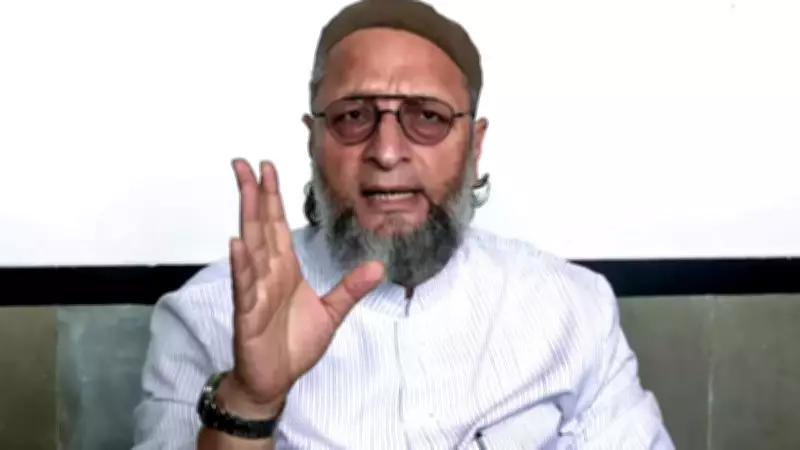
AIMIM chief Asaduddin Owaisi on Friday asserted that if offering namaz on roads is deemed inappropriate, then similar restrictions must apply to religious activities of all faiths. He invoked Article 25 of the Constitution, which guarantees the freedom of religion and the right to freely practice and profess one's faith.
Owaisi's Remarks at Eid Milap Event
Addressing an Eid Milap event, Owaisi argued that public objections to namaz reflect a double standard. He questioned why similar concerns are not raised over religious processions and gatherings organized by other communities.
"Remember Article 25. If offering prayers on the road is wrong, then it is wrong for every religion's festival to come out onto the road. If you say meat shops should be closed during someone's festival, then close liquor shops for the 30 days of Ramadan. Close liquor shops for 30 days," Owaisi said.

Allegations of Discrimination
Owaisi alleged a deliberate bias against Muslims, stating that people have no objection to Prime Minister Narendra Modi's speeches but object to Azaan and Namaz. He also criticized restrictions imposed during Hindu festivals on the sale of eggs, meat, and chicken, asking, "What kind of law is this?"
"Your hatred is solely for Muslims. And your hatred clearly shows that you want to suppress the followers of this religion and marginalise them. You want to make them second-class citizens," he said.
Political Context
The AIMIM president claimed that issues related to Azaan and Namaz are deliberately raised whenever major Muslim festivals such as Ramzan or Bakrid approach. "Problems with the Azaan, problems with Namaz. After all, what has happened to you people?" he asked.
His remarks come amid an ongoing political debate over prayers in public spaces and recent directives by authorities in several states aimed at ensuring that religious gatherings do not disrupt traffic or public movement.
Recent Developments
Uttar Pradesh Chief Minister Yogi Adityanath recently said that namaz should be offered in a regulated manner and, if required, could be conducted in multiple shifts to avoid inconvenience to the public. He stated that authorities would first seek compliance through persuasion before taking further steps to enforce public order norms.
In West Bengal, the government led by Suvendu Adhikari decided not to allow the traditional Eid congregation on Kolkata's Red Road and shifted the gathering to Brigade Parade Grounds to prevent prayers from spilling onto public roads.
Comparison with Other Religious Events
Continuing his criticism, Owaisi drew comparisons with religious yatras and processions, saying roads are frequently occupied during such events without attracting similar objections. On namaz being offered on roads, he said that it happens only for Friday prayers or Eid and not every day.
"In India, festivals of every religion take place on the road, don't they? You don't see those; you go blind to them," he said.
(With inputs from ANI)






