

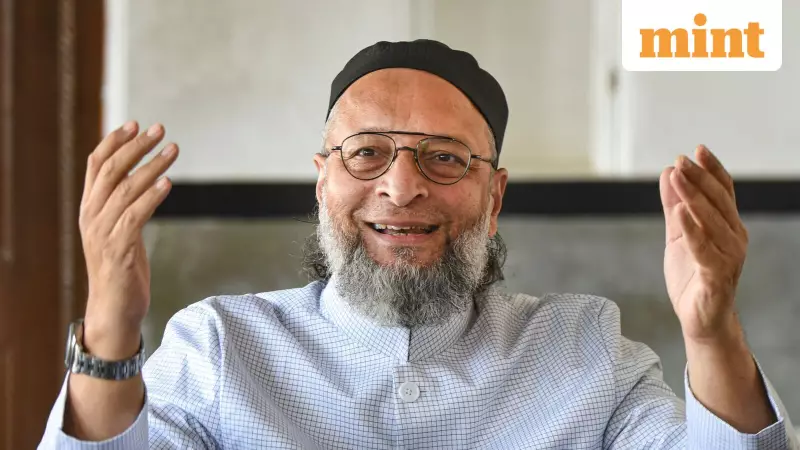
All India Majlis-e-Ittehadul Muslimeen (AIMIM) president Asaduddin Owaisi expressed heartfelt gratitude to the voters of Maharashtra on Saturday. He thanked them for electing 125 of his party's candidates as corporators across various municipal corporations in the state.
Owaisi Calls for Introspection Among Defeated Parties
During a press conference held in Hyderabad, Owaisi suggested that political parties facing defeat in the elections should engage in deep introspection. He directly addressed those who frequently label AIMIM as the BJP's 'B team'.
"Now those parties who abuse us should think of themselves," Owaisi stated firmly. "It is the decision of the people. There is an English saying that victory has many fathers, defeat has none."

The Hyderabad MP emphasized that the election results speak for themselves. He highlighted a particularly telling outcome in the area where Maharashtra Chief Minister Eknath Shinde resides.
"Uddhav Thackeray's candidate emerged victorious in the specific area where Chief Minister Eknath Shinde lives," Owaisi pointed out, letting the political implications hang in the air.
Preparing for Telangana Municipal Elections
Looking ahead, Owaisi revealed that AIMIM is now actively preparing for upcoming municipal elections in Telangana. The party leadership has already begun the process of identifying potential candidates.
"We have invited names from potential candidates," he confirmed, indicating the party's forward-looking strategy.
When questioned about the possibility of reconciliation between the Thackeray cousins, Owaisi kept his response concise. "Our party has won. I am happy. I do not know about others," he remarked, focusing on his own party's achievements.
Confidence in Newly Elected Corporators
Owaisi voiced strong confidence that the newly elected corporators would remain loyal to AIMIM's mandate. However, he acknowledged the practical realities of Maharashtra politics.
The party is implementing necessary safeguards to prevent any potential poaching attempts by rival political groups. This precautionary measure reflects the competitive nature of municipal politics in the state.
Dismissing 'B Team' Allegations
Addressing persistent allegations that AIMIM functions as the BJP's 'B team', Owaisi dismissed the claims with characteristic directness.
"I have no remedy for such baseless accusations," he stated, effectively brushing aside what he considers unfounded political rhetoric.
He also addressed questions about the accuracy of voters' lists, confirming his belief in their correctness. This statement comes amid some political parties questioning election procedures.
BJP Emerges as Dominant Force in Maharashtra
The broader election results reveal a significant political shift in Maharashtra. The Bharatiya Janata Party (BJP) secured 1,425 of the 2,869 seats across 29 municipal corporations.
This performance establishes the BJP as the dominant political force in the state's urban centers. The party made particularly significant inroads into traditional strongholds of established political families.
Breaking Thackeray's Mumbai Stronghold
In a historic development, the BJP claimed 89 seats within the 227-member Brihanmumbai Municipal Corporation (BMC). This effectively terminated the Thackeray family's thirty-year control over India's wealthiest civic organization.
The BMC results show a fragmented political landscape:
- BJP: 89 seats
- Shiv Sena (Shinde faction): 29 seats
- Shiv Sena (UBT): 65 seats
- MNS: 6 seats
- Congress-VBA alliance: 24 seats
- AIMIM: 8 seats
- NCP: 3 seats
- Samajwadi Party: 2 seats
- NCP (SP): 1 seat
BJP's Statewide Municipal Dominance
Beyond Mumbai, the BJP established itself as the leading party in numerous municipal corporations across Maharashtra:

- Navi Mumbai: 65 seats
- Kalyan-Dombivli: 50 seats
- Mira-Bhayandar: 78 seats
- Nashik: 72 seats
- Panvel: 55 seats
- Pune: 119 seats
- Pimpri-Chinchwad: 84 seats
- Solapur: 87 seats
- Chhatrapati Sambhajinagar: 57 seats
- Nanded: 45 seats
- Nagpur: 102 seats
This comprehensive performance represents a substantial reconfiguration of Maharashtra's municipal political landscape. The results suggest shifting voter preferences and evolving political alliances across the state's urban centers.





