

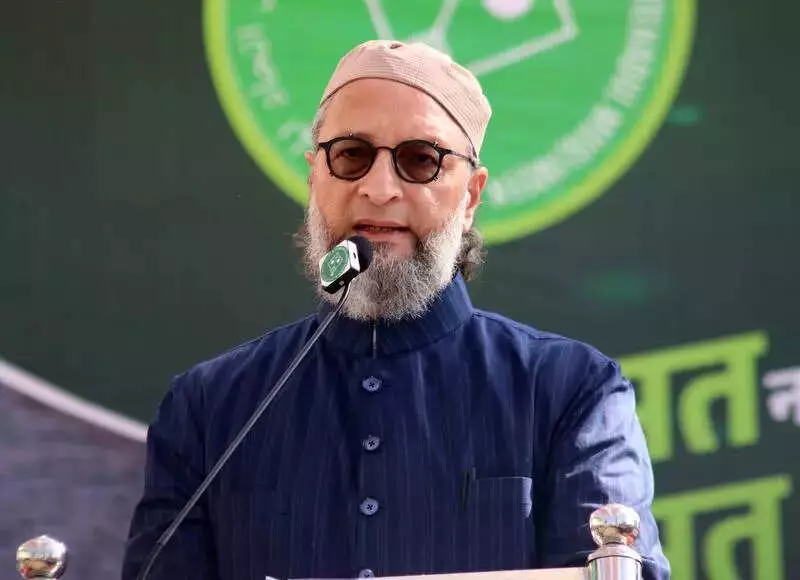
Hyderabad MP and AIMIM president Asaduddin Owaisi delivered a sharp rebuttal on Sunday to Assam Chief Minister Himanta Biswa Sarma's recent assertion that the Prime Minister of India will always be a Hindu. The political clash, centered on constitutional interpretation, unfolded as Owaisi campaigned in Maharashtra ahead of local body elections.
Owaisi's 'Tubelight' Jibe and Constitutional Defense
Addressing the media in Nagpur, Owaisi launched a direct attack on Sarma's understanding of India's founding document. He metaphorically suggested there was a 'tubelight' in the Assam CM's head, implying a delay in comprehension. Owaisi emphasized that Sarma, like all public representatives, had taken an oath on the Constitution, which contains no such religious stipulation for the highest office.
Drawing a critical comparison, the Hyderabad MP noted that Pakistan's Constitution explicitly mentions that only a person from a specific community can become Prime Minister or President. "In our country, Babasaheb BR Ambedkar gave us the Constitution. He was more intelligent and educated than Himanta Biswa Sarma," Owaisi stated, upholding the secular and inclusive vision of the architect of the Indian Constitution.

The Genesis of the Debate: A 'Hijab-Clad' PM Dream
The controversy originated from Owaisi's speech a day earlier in Solapur, Maharashtra. On Saturday, while praising the inclusive spirit of Ambedkar's Constitution, he expressed a personal aspiration. Owaisi said it was his dream that one day a 'hijab-clad daughter' would become the Prime Minister of India, affirming that the Constitution allows any citizen to aspire to the posts of PM, Chief Minister, or Mayor.
Reacting to this, Himanta Biswa Sarma had stated that while constitutionally there was no bar, India as a Hindu civilization would always have a Hindu Prime Minister. "But India is a Hindu nation, a Hindu civilisation, and we will always believe, and we are extremely confident that the Indian Prime Minister will always be a Hindu person," the Assam CM had said, framing the issue within a majoritarian cultural context.
Core Argument: The Spirit of the Constitution
In his final rebuttal, Owaisi condensed the debate to a fundamental principle. He argued that some individuals fail to grasp both the letter and the spirit of the Constitution. Owaisi firmly asserted that the country does not belong to any single community, implicitly championing its pluralistic and democratic character as envisioned by its framers.
This exchange highlights the ongoing and potent political discourse in India surrounding secularism, majority identity, and constitutional values. The remarks from both leaders are set against the backdrop of the upcoming civic body elections in Maharashtra, where such national debates often influence local campaigning.






