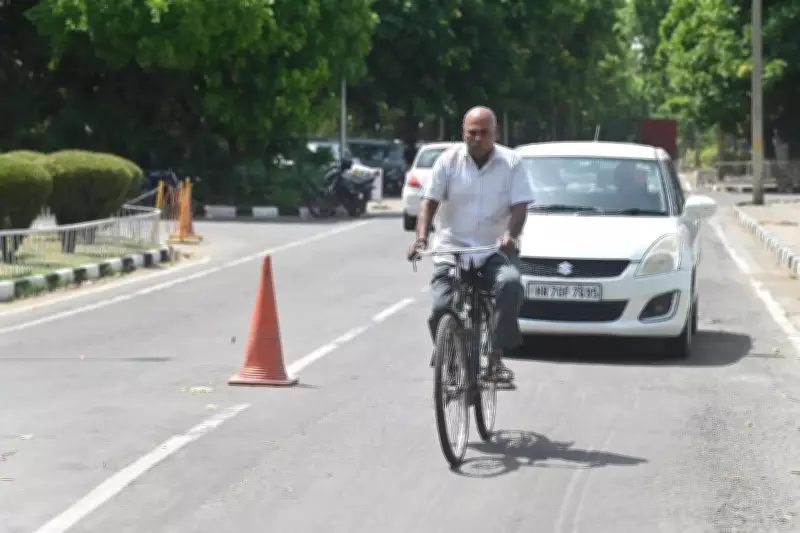
Chandigarh: Nearly 2,500 to 3,000 vehicles enter Panjab University (PU) every day. At a campus where Wednesdays have now officially been declared “vehicle-free” and where bicycles once dominated internal roads, the numbers point to a stark reality: PU is no longer the cyclist-friendly campus many students and teachers remember.
The university’s recent Vehicle-Free Wednesday initiative, announced through a notice issued on May 25, urges students, faculty and staff to avoid bringing private vehicles to campus and instead use shuttle buses and e-rickshaws operating within the university. However, even on Wednesdays, cars continue to occupy parking stretches and move through internal roads, highlighting the scale of PU’s growing dependence on motor vehicles.
For many on campus, the issue goes beyond traffic congestion. It reflects a dramatic shift in the way people move around the university.

Unlike many institutions now investing in cycling infrastructure, PU historically never needed dedicated cycling tracks. Students cycled between departments, hostels and libraries because bicycles were the preferred mode of transport and vehicular traffic remained limited. Today, cyclists say the campus feels far less accommodating. “Earlier, you could cycle across campus without giving it a second thought. Now, you have to remain alert because there are vehicles everywhere,” said a second-year UG student who regularly cycles to classes. “People talk about cycle tracks today, but the real issue is that the campus has become dominated by cars.”
University authorities have attempted to regulate the increasing number of vehicles over the years. Earlier assessments estimated that around 2,500 to 3,000 vehicles enter the campus daily, with nearly 30% believed to belong to outsiders or unauthorised visitors. The university also introduced QR-coded vehicle stickers and identified nearly 4,000 vehicles belonging to day scholars as part of efforts to manage access.
Yet many believe the larger challenge lies in changing habits. Panjab University Teachers’ Association president Prof Amarjit Naura, who continues to commute inside the campus on a bicycle, said the transformation has occurred gradually over the years.
“We have changed our lifestyles. Today, for every small task, we want to use a car. That habit has increased significantly,” he said. Recalling his student days at the university in 1994, Naura said private vehicles were uncommon on campus.
“When I joined PU as a student in 1994, hostels would hardly have one or two scooters, leave alone cars. I stayed in Hostel No. 6. If the mess was closed, students would simply walk to Sector 15 or nearby areas for food. Walking and cycling were normal parts of everyday life,” he said.
According to Naura, the number of cars on campus has increased to a level where it is affecting the overall character of the university. “There are too many vehicles on campus today. We need to rethink our lifestyles and reduce dependence on cars wherever possible,” he said.
The changing landscape of the campus is also evident in its physical spaces. Former PU student Jaskaran Tiwana said locations that once accommodated cyclists now tell a different story.
“Where there are canteens today, there used to be cycle stands. Cycles were everywhere. You would see rows and rows of bicycles parked outside departments and common areas,” he said.
According to Tiwana, cycle stands have gradually disappeared from several parts of the campus as commuting patterns changed. “Today, you hardly notice cycle stands because very few people come on bicycles. Cars and two-wheelers have become the default mode of transport,” he said.
Students and faculty say the consequences are visible not only in parking congestion but also in safety concerns.
Prof Amit Chauhan, who occasionally cycles on the campus during early morning hours, said cycling becomes significantly more challenging during the day. “I do cycle in the mornings when traffic is relatively low. But during the day, it is not very feasible because the infrastructure required for safe cycling is missing,” he said.

Chauhan said the issue is not merely about the absence of dedicated cycle tracks but also the growing volume of vehicular traffic on internal roads. “When the number of vehicles was low, people could comfortably use bicycles without requiring separate infrastructure. Today, traffic conditions are very different and that changes the cycling experience,” he said.
As PU pushes its Vehicle-Free Wednesday initiative and continues efforts to regulate vehicle entry, many students and teachers see the campaign as an opportunity to revive a culture that once defined campus life.
For them, the debate is not merely about introducing cycle tracks or reducing traffic on a particular day. It is about whether a university that once functioned effortlessly on bicycles can reclaim some of the habits that made it one of the region’s most walkable and cyclist-friendly campuses.