

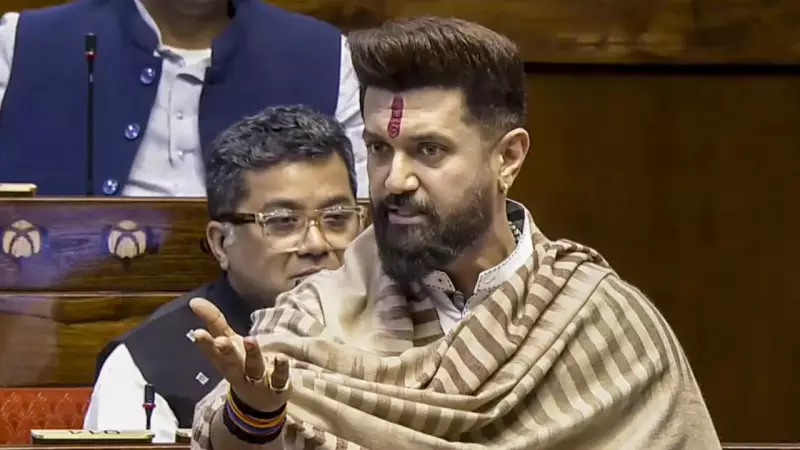
Union Minister and Lok Janshakti Party (Ram Vilas) chief Chirag Paswan launched a sharp attack on the Congress and the Rashtriya Janata Dal (RJD) on Sunday. He accused them of deliberately spreading a "misleading narrative" around key government initiatives, including the Mahatma Gandhi National Rural Employment Guarantee Act (MGNREGA) and its successor, the VB-G RAM G scheme.
Opposition Engaged in Politics of Fear, Claims Paswan
Addressing the media in New Delhi, Paswan asserted that parties like the Congress and RJD have consistently used fear as a political tool. He claimed they misrepresent laws and schemes such as the Citizenship Amendment Act (CAA), National Register of Citizens (NRC), Mukhyamantri Mahila Rozgar Yojana, and the newly introduced VB-G RAM G to create panic among the public.
He specifically criticized the opposition for sensationalising the renaming of MGNREGA by invoking Mahatma Gandhi's legacy. The minister challenged them to debate the substantive merits of the VB-G RAM G scheme rather than focusing on its title. Paswan also pointed to the opposition's criticism of exercises like the special intensive revision (SIR) of electoral rolls, stating that the people of Bihar had already rejected their "vote chori" allegations through the democratic process.

Protests to Politically Benefit NDA in Key States
Paswan made a bold prediction, stating that the opposition's agitations would ultimately backfire and consolidate votes in favour of the National Democratic Alliance (NDA). He drew a parallel with the political scenario in Bihar, where he claimed similar protests around the SIR helped the NDA secure victory.
"Just like they helped us win Bihar by creating a ruckus around SIR, they will assist us in clinching West Bengal and Assam by trying to make an issue out of VB-G RAM G," the Union Minister stated confidently. He emphasised that the NDA is poised to form "double-engine governments" in the remaining states, including West Bengal and those in southern India.
Defending VB-G RAM G and Attacking MGNREGA's Legacy
In a robust defense of the VB-G RAM G Act, Paswan explained that it embodies the principle of collective responsibility within India's federal structure. He dismissed opposition claims that the act places an unfair financial burden on states, arguing that shared responsibility was essential for success.
He attributed the perceived failures of MGNREGA to the absence of this very collective ownership, suggesting states did not feel accountable. According to Paswan, VB-G RAM G introduces significant improvements: it increases the number of guaranteed working days, shifts the focus from mere "earth digging" to meaningful infrastructure projects, and implements stricter monitoring to eliminate corruption and loopholes.
Taking a direct jab at the Congress, Paswan questioned their sudden concern for state finances. "Why are they worried about the burden on states? In how many states do they have a government anyway?" he asked. He further alleged that the Congress was upset because the Modi government had dismantled a scheme they had "devised for carrying out corruption," claiming MGNREGA had become a "den of corruption" that primarily benefited middlemen instead of the intended poor beneficiaries.






