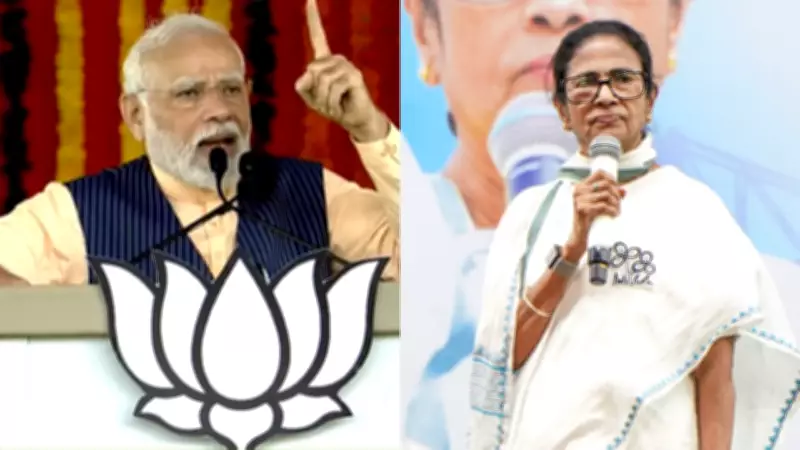
Prime Minister Narendra Modi Launches Political Offensive Against TMC Government in West Bengal
In a significant political development, Prime Minister Narendra Modi marked the Bengali New Year celebration of Poila Boishakh by addressing the people of West Bengal through a detailed letter. The communication, released on Wednesday, served dual purposes: extending traditional festival greetings while simultaneously launching a comprehensive critique of the Mamata Banerjee-led Trinamool Congress administration that has governed the state for fifteen years.
Allegations of Systemic Failure and Corruption
The Prime Minister's correspondence contained pointed accusations against the state government, characterizing its tenure as a period marked by widespread corruption, administrative chaos, and systematic misrule. Modi asserted that these governance failures have fundamentally compromised the rights and dignity of ordinary citizens across West Bengal.
"For the past decade and a half, West Bengal has endured misrule, disorder, and corruption that have systematically deprived common people of their basic rights, personal dignity, and access to the state's rich cultural heritage," the Prime Minister stated unequivocally in his letter.

Specific Concerns About Safety and Opportunity
PM Modi elaborated on specific areas where he believes the current administration has failed the people of West Bengal:
- Women's Safety: The Prime Minister expressed concern about compromised security for women, suggesting they face limitations in moving freely without fear.
- Youth Employment: He highlighted the lack of employment opportunities that forces young people to seek work outside the state.
- Economic Rights: Modi emphasized the erosion of rights for economically disadvantaged communities.
Vision for a Developed West Bengal
Contrasting the current situation with historical achievements, the Prime Minister invoked West Bengal's legacy as a region that once provided national leadership and direction. He called for collective action toward building what he termed a "developed West Bengal" with specific benchmarks:
- Elimination of hunger with food security for all citizens
- Enhanced safety enabling women to move freely without apprehension
- Creation of sufficient employment opportunities to retain youth within the state
"Let us unite in our commitment to construct a developed West Bengal where no impoverished person goes to bed hungry, where every individual has reliable access to nourishment, where women feel secure enough to leave their homes without trepidation, and where young people no longer need to migrate elsewhere in search of livelihood," Modi appealed to the electorate.
Electoral Context and Political Stakes
The Prime Minister explicitly connected West Bengal's future trajectory to the outcome of the impending assembly elections, framing the contest as a decisive moment for the state. He characterized the electoral process as "a confrontation between truth and falsehood" and encouraged maximum participation in what he described as the "festival of democracy."
Modi expressed confidence that voters would support the Bharatiya Janata Party, potentially enabling what he termed a "historic victory" that would transform the state's governance. "I provide my assurance that following the establishment of a BJP government in West Bengal, the state will progress alongside the rest of the nation on the developmental pathway and reclaim its historical position as a developed region," he pledged.
Electoral Timeline and Historical Context
West Bengal is scheduled to conduct voting in two phases on April 23 and April 29, with vote counting planned for May 4. In the previous 2021 assembly elections, the Trinamool Congress achieved a decisive victory by securing 213 seats, while the BJP emerged as the principal opposition with 77 seats. The Congress party and Left Front failed to win any constituencies in that electoral contest.