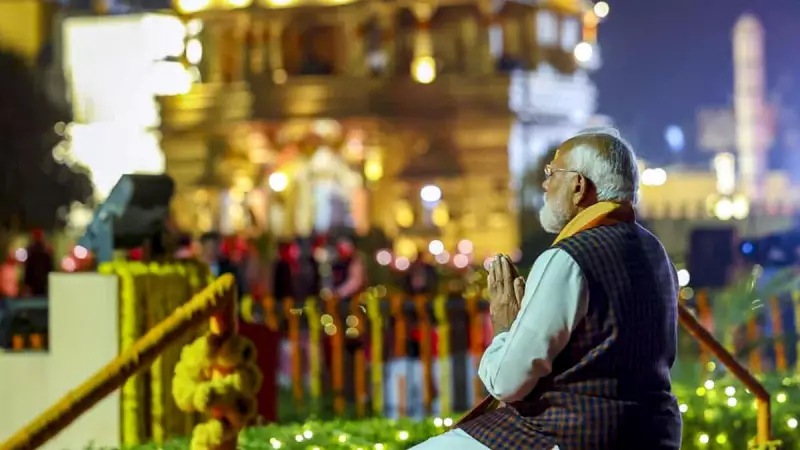
Prime Minister Narendra Modi led a significant and symbolic 'Shaurya Yatra' (Valour March) in Gujarat on Saturday, marking a pivotal moment in the ongoing 'Somnath Swabhiman Parv' celebrations. The event, held in Veraval, served as a powerful tribute to the resilience and cultural resurgence embodied by the reconstruction of the historic Somnath Temple.
A March Steeped in History and Sacrifice
The Shaurya Yatra commenced from the iconic Somnath Temple, a site that has witnessed destruction and reconstruction multiple times throughout history. Prime Minister Modi, walking alongside a diverse group of participants, traced a route that culminated at the 'Prabhas Patan' area. This march was not merely a physical journey but a re-enactment of a historic procession that took place over seven decades ago.
The original yatra in 1947 was led by Sardar Vallabhbhai Patel, India's first Deputy Prime Minister, who laid the foundation stone for the temple's reconstruction. It symbolized the nation's determination to restore its cultural pride after independence. Saturday's event, therefore, was a direct homage to Sardar Patel's vision and the collective will of the people who contributed to the temple's revival.

Commemorating the Somnath Swabhiman Parv
The Shaurya Yatra forms the emotional core of the 'Somnath Swabhiman Parv,' a festival of self-respect organized to commemorate the 75th anniversary of that foundational event. The Parv celebrates the successful reconstruction of the temple, which was completed in 1951 and later consecrated by then President Rajendra Prasad in 1962.
During his address, Prime Minister Modi connected this historical struggle to contemporary India's journey. He emphasized that the reconstruction of Somnath was a defining moment that ignited a nationwide spirit of reclaiming and preserving India's ancient heritage. The Prime Minister stated that the temple stands today as a testament to India's unbroken civilizational consciousness and its capacity for renewal.
Symbolism and National Message
The event was rich with symbolism, linking past sacrifices with present achievements and future aspirations. By personally leading the yatra, PM Modi underscored the continuity of the national project initiated by leaders like Sardar Patel.
He framed the narrative of Somnath's revival as a precursor to the recent consecration ceremony at the Ram Temple in Ayodhya, suggesting a pattern of national cultural restoration. The Prime Minister's presence highlighted the government's focus on projects that resonate with cultural and historical sentiments, reinforcing a message of pride and sovereignty.
The Shaurya Yatra successfully blended historical remembrance with contemporary political discourse. It served as a platform to honor the legacy of India's freedom fighters and early leaders while projecting a vision of a confident, culturally rooted nation moving forward. The event concluded with a renewed sense of connection to a pivotal chapter in India's post-independence history, celebrated in the very land where that history was made.