

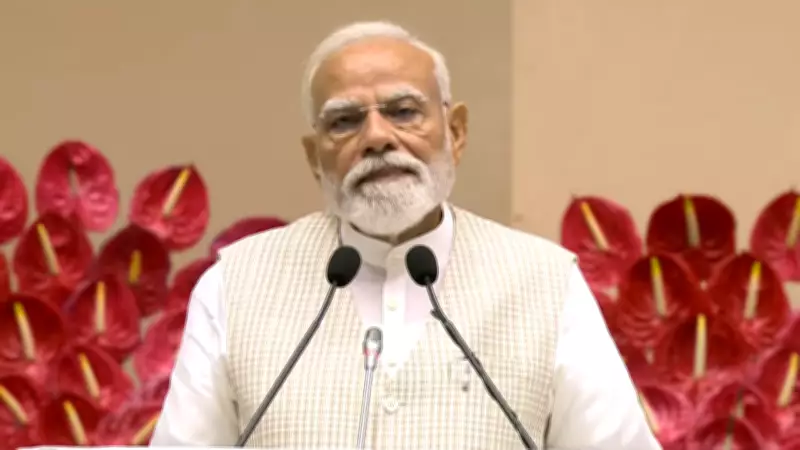
PM Modi Declares India on Brink of Historic Women's Reservation Implementation
Prime Minister Narendra Modi on Monday proclaimed that India stands "on the brink of making history" as the long-pending women's reservation in legislatures moves closer to implementation. Addressing the 'Nari Shakti Vandan Sammelan' in Delhi, the Prime Minister asserted that this transformative reform will significantly deepen democracy and accelerate women-led development across the nation.
Collective Aspiration Nears Parliamentary Reality
PM Modi emphasized that the proposed legislation reflects a powerful collective aspiration that has been building momentum across the country for decades. "Parliament is now close to taking a decisive step that would reshape representation in politics," he declared, noting that women across India have been actively discussing this topic in recent days.
"Reaching the Legislative Assembly and the Lok Sabha will give wings to their dreams," the Prime Minister stated, connecting the current movement to India's historical foundations. "From the freedom struggle to the decisions of the Constituent Assembly, Indian women have made immense contributions to laying the foundations of independent India."

Women's Political Legacy and Global Recognition
PM Modi highlighted the distinguished legacy of women in Indian leadership positions, from the President to the Prime Minister, noting they have created unique legacies that enhanced both the dignity and pride of the nation. He pointed out that women currently hold key positions including the President and Finance Minister.
The Prime Minister shared remarkable statistics about women's participation in local governance: over 1.4 million women are successfully serving in local government bodies, with approximately 21 states achieving nearly 50 percent participation in Panchayats.
"Whenever I discuss this topic with foreign guests, they are left speechless," PM Modi revealed. "They are astonished. This is no ordinary thing. This active participation of millions of women in politics and social life is astonishing even to the world's most prominent leaders and political experts, and it brings immense pride to India."
Clear Implementation Timeline and Parliamentary Process
The government has committed to implementing the constitutional amendment within a clear timeline, with PM Modi stating: "There was also a unanimous demand that it should be implemented by 2029 at any cost. We are keeping the 2029 deadline in mind."
A comprehensive discussion on the legislation is scheduled to take place in Parliament from April 16th. "It is our endeavour and our desire that this work be done with mutual cooperation and participation," the Prime Minister emphasized. "With everyone's collective efforts, the dignity of the entire House will reach new heights. Every woman in the country will also be happy that every party has risen above politics and taken up this important task for their benefit."
Transformative Legislation for Future India
Describing the move as transformative, PM Modi stated: "This decision is dedicated to women's power. It is dedicated to the veneration of women's power. Our country's Parliament is close to creating a new history."
He envisioned this as history that will realize concepts of the past while fulfilling resolutions for the future—a resolution for an India that is egalitarian, where social justice is not just a slogan, but a natural part of our work culture and decision-making process.
"The time has come to end decades of waiting," PM Modi declared, referencing the parliamentary dates of April 16th, 17th, and 18th for this historic deliberation.
Political Support and Structural Change
Delhi Chief Minister Rekha Gupta welcomed the Centre's push to operationalize the Nari Shakti Vandan Adhiniyam, 2023, stating that the proposed 33 percent reservation in the Lok Sabha and state assemblies would place women empowerment on "auto mode." She highlighted how the initiative reflects a significant shift toward women-led development and acknowledged welfare measures introduced under the current government.

National Commission for Women chairperson Vijaya Rahatkar also praised the legislation, noting it fulfills former Prime Minister Atal Bihari Vajpayee's vision of greater political representation for women. She emphasized that this marks a structural change in decision-making spaces that will have far-reaching implications for Indian democracy.
Parliamentary Action Ahead
The government is expected to bring both the constitutional amendment and a delimitation bill during the upcoming special parliamentary session starting April 16th. This legislative package represents one of the most significant political reforms in recent Indian history, potentially reshaping the composition of both state assemblies and the national Parliament for generations to come.
As India approaches this historic milestone, the women's reservation bill stands as a testament to the evolving nature of Indian democracy and the growing recognition of women's indispensable role in nation-building and governance.





