

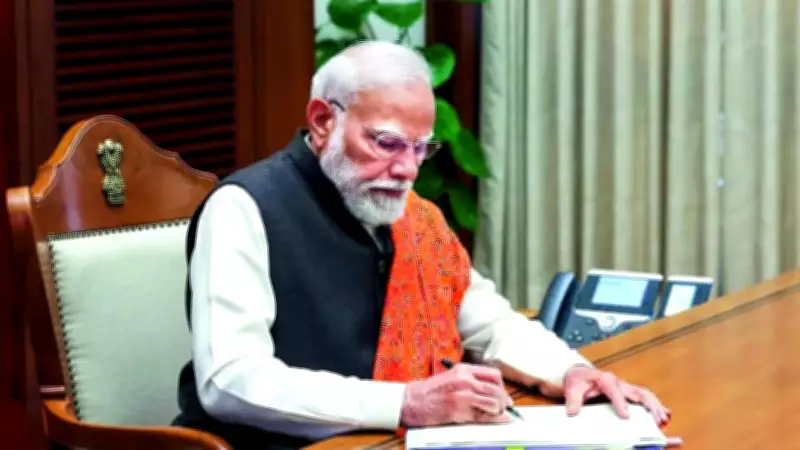
Historic Shift: PMO Moves to Seva Teerth After 78 Years in South Block
In a landmark transition marking the end of a colonial-era legacy, the nerve center of India's central government officially relocated on Friday from the historic South Block to the newly constructed Seva Teerth. This monumental move, occurring after 78 years, signifies a profound symbolic and administrative transformation in the nation's governance architecture.
Final Cabinet Meeting in British-Era Building Approves Major Projects
The relocation was preceded by a significant cabinet meeting held within the British-era South Block, where proposals collectively valued at over Rs 1.5 lakh crore were deliberated and approved. These substantial initiatives encompass a diverse range of national infrastructure developments, including the ambitious construction of an underwater road-cum-rail tunnel across the Brahmaputra River, multiple expansive highway and railway projects, a new Metro link in Noida, and the establishment of the Urban Challenge Fund aimed at promoting sustainable urbanisation across the country.
PM Modi Inaugurates New Complex, Highlights Governance Transformation
Following the inauguration ceremony of Seva Teerth and two newly built Kartavya Bhawans, Prime Minister Narendra Modi addressed the nation, articulating a clear vision for this new chapter. He emphasized that over the past 11 years, a new model of governance has emerged, fundamentally placing citizens at the very center of decision-making processes. "The decisions made here in these new buildings will serve as the foundational bedrock for advancing the ambitions and aspirations of our 140 crore citizens, rather than reflecting the will or command of a monarch," stated the Prime Minister, directly referencing the colonial origins of the South Block.

Shedding Colonial Legacy: From Symbols of Empire to Aspirations of India
Prime Minister Modi provided a poignant historical context, tracing the origins of the PMO back to a modest Prime Minister Secretariat established in 1947 to provide basic administrative support. He contrasted the philosophical underpinnings of the old and new structures. "South Block and North Block, which until now housed critical ministries like Defence, Home, and Finance, alongside the PMO, were conceived and built to embody the ideals and dominance of the British Empire," he explained. "In stark contrast, these new edifices—Seva Teerth and Kartavya Bhawan—have been purposefully built to realize the genuine aspirations and dreams of the Indian people."
He underscored the importance of remembering that these colonial structures on Raisina Hill, which became India's capital after the shift from Kolkata in 1931, were originally erected as symbols of British imperial power. As India strides purposefully towards the goal of a 'Viksit Bharat' or Developed India, Modi asserted that it is vital for the nation to consciously shed every lingering trace of the colonial mindset and the mentality of subservience.
Renaming as Reorientation: From Power to Service
The Prime Minister connected this physical move to a broader, ongoing philosophical reorientation. He cited the renaming of iconic locations—such as Race Course Road to Lok Kalyan Marg and Rajpath to Kartavya Path—as emblematic of this shift. These actions, he clarified, are not merely superficial changes of nomenclature. Instead, they represent a concerted and deep-seated effort to transform the very mindset associated with governance—from one centered on power and authority to one fundamentally rooted in the spirit of public service and duty ('Kartavya').
Vision for 2047: Governance as the Cornerstone of National Identity
Addressing government employees, whom he referred to as 'karmayogis', PM Modi urged them to dedicate their best efforts in this new environment. He projected a vision where India's future identity will be defined not solely by the scale of its economy, but equally by the quality of its governance, the clarity and effectiveness of its policies, and the unwavering dedication of its public servants.

He framed every future decision taken within Seva Teerth as a critical step shaping the trajectory towards a developed India by the landmark year 2047. "2047 is not just a date on the calendar," Modi proclaimed. "It is the collective timeline of 140 crore dreams. In this journey, every institution, every officer, every employee, and every 'karmayogi' holds profound significance."
Seva Teerth: Envisioned as a Beacon of Sensitive Governance
Concluding his address, the Prime Minister articulated his aspiration for Seva Teerth. He expressed his desire for the new complex to become a living symbol and beacon of sensitive, citizen-centric governance—a place where the visibility of genuine service replaces the aura of power, where commitment to public welfare supersedes preoccupation with position, and where a profound sense of responsibility transcends the mere exercise of authority.





