Selective Scrutiny Undermines Democratic Accountability
For much of the past decade, India has witnessed developments that would ordinarily provoke sustained public debate and media examination. Foreign policy challenges, economic distress, youth unemployment, agrarian crisis, widening inequalities, shrinking institutional autonomy, and the growing distance between constitutional ideals and administrative practice are not minor concerns. They touch the everyday lives of millions, yet these issues have rarely generated the intensity of discussion that accompanies every disagreement within the opposition camp.
One often gets the impression that a section of the media and political commentary has settled into an unusual role. Instead of holding power accountable, it has become preoccupied with explaining power, defending power, and occasionally inventing narratives that soften the consequences of governmental failures.
The Inversion of Accountability
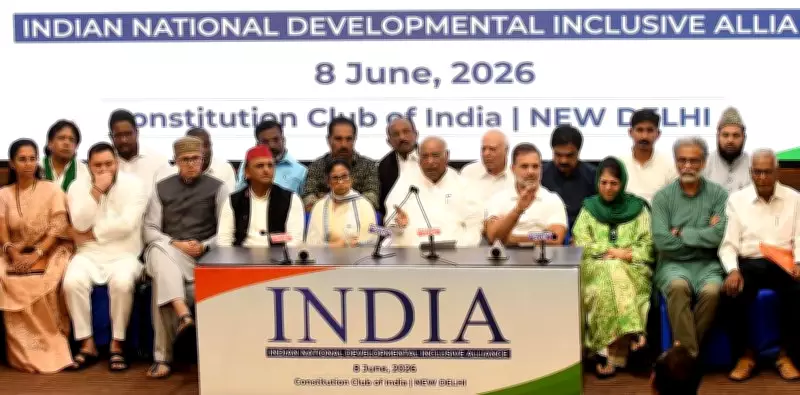
This pattern tells us about the changing standards through which democracy itself is evaluated. Over the last few years, one notices a curious inversion. The opposition, particularly the INDIA alliance, has often been subjected to greater scrutiny than the ruling establishment. The expectation of accountability seems to operate with extraordinary vigour when directed at those outside power and with remarkable restraint when directed at those who exercise it. The issue is not that the opposition is questioned, but that those who govern are questioned so little.

Democracy, no doubt, demands scrutiny. Political parties, especially those aspiring to govern, must answer difficult questions. They must explain their choices, justify their alliances, and demonstrate coherence in their political conduct. The problem arises when this scrutiny becomes selective. It then ceases to be a democratic instrument and begins to resemble a political habit.
Disproportionate Focus on Opposition Disagreements
This pattern became visible once again after the recent political developments in West Bengal and the subsequent Upper House elections in two states. Almost immediately, a familiar chorus emerged. Is the INDIA alliance finished? Has the opposition lost direction? Was the alliance fundamentally flawed from the beginning? These questions are legitimate as political alliances are not sacred entities. They succeed, falter, evolve, and sometimes collapse. But what is remarkable is the disproportionate energy with which such questions are pursued. One could almost believe that the greatest crisis confronting Indian democracy today is the existence of disagreements within the opposition rather than the concentration of power at the very apex of the political system.
Resource Asymmetry and Institutional Vulnerability
The tendency to examine the opposition in isolation is itself a form of intellectual dishonesty. Political actors do not operate in a vacuum; their strengths and weaknesses are shaped by the institutional environment in which they operate. The reality is that contemporary Indian politics is characterised by inequalities that have few precedents in independent India's electoral history. The asymmetry is financial, institutional, organisational, and communicative. The resources available to the ruling party are so vast that opposition parties across regions, languages, and ideological traditions struggle to compete on even remotely equal terms.
Yet resources alone do not explain the imbalance. There is a deeper and more troubling dimension to the present moment. Increasingly, opposition politics unfolds under the shadow of institutions that appear vulnerable to political influence. Investigative agencies are repeatedly accused of displaying selective enthusiasm. Cases move swiftly in some circumstances and mysteriously slow down in others. Political defections are frequently accompanied by dramatic changes in legal fortunes. Whether every such allegation is true is less important than the fact that the perception has become widespread.

Erosion of Trust and the Cost of Dissent
Democracy rests on the appearance of fairness. Institutions derive legitimacy from public confidence. But once citizens suspect that power determines institutional behaviour, trust erodes. Fear is rarely acknowledged as a formal political instrument, even though democracies are not supposed to function through fear. Yet one cannot ignore the growing number of politicians, activists, journalists, academics, and civil society actors who speak of intimidation, surveillance, legal pressure, and administrative harassment. Dissent increasingly carries a cost, and the tragedy is that these developments are often normalised. What should provoke concern is treated as routine, and what should invite resistance is accepted as inevitable.
The Judiciary and Democratic Equilibrium
For many years, citizens looked towards the judiciary as a constitutional counterweight capable of preserving democratic equilibrium. The courts represented the possibility that power, however overwhelming, would ultimately encounter institutional restraint. The fact that increasing numbers of citizens now express anxiety about this expectation is itself indicative of the democratic mood of the times. None of this means that the INDIA alliance should be absolved of responsibility. On the contrary, the opposition faces both real and serious challenges. Internal contradictions exist. Party-based ambitions may collide with collective objectives, and personal rivalries may sometimes overwhelm political priorities. Electoral understandings remain fragile in several states, and pretending that these problems do not exist would serve no purpose.
Coalitions and the Need for Political Imagination
Yet there is a difference between acknowledging weaknesses and exaggerating them into evidence of inevitable failure. Coalitions are inherently messy, particularly in a country as socially diverse as India. Alliances are rarely built upon perfect agreement. We have historical evidence that they emerge from negotiation, compromise, and the recognition of shared challenges.
The larger question is whether the opposition possesses the imagination to move beyond electoral calculations and rediscover political purpose. The future of democratic politics in India cannot depend exclusively upon parliamentary arithmetic. Numbers matter, but numbers follow politics; they do not create it. If the opposition seeks renewal, it must return to society itself. It must rediscover the language of public engagement, social movements, and democratic mobilisation.
Beyond Elections: The Terrain of Public Life
Perhaps the greatest mistake many political parties have made over the years has been assuming that elections alone constitute politics. Elections are important, but democracy does not begin and end with voting day or counting day. Between two elections lies the vast terrain of public life where citizens struggle with unemployment, inflation, insecure livelihoods, discrimination, inadequate healthcare, educational exclusion, and social vulnerability.
It is here that a meaningful alternative must be constructed. The opposition must articulate a politics capable of bringing together questions of class and identity rather than treating them as separate domains. Economic justice and social justice are not competing agendas because they are interconnected dimensions of democratic citizenship. A politics rooted in these realities has the potential to transcend narrow electoral calculations.
Narrative and Communication Challenges
The ruling establishment has mastered the art of political communication. It has demonstrated an extraordinary ability to shape narratives, dominate public discourse, and transform political contests into cultural spectacles. Opposition parties cannot succeed merely by reacting to these narratives. They must generate narratives of their own, grounded in the lived realities of the people of our land.
The challenge before the INDIA alliance is therefore not simply organisational but also philosophical. It must convince citizens that democracy is not merely a mechanism for choosing rulers but a framework through which power remains accountable, institutions remain autonomous, and citizens remain free to disagree.
The Health of the Democratic Ecosystem
Ultimately, the debate is not about whether the opposition is perfect, since no opposition is. The more relevant question concerns the health of the democratic ecosystem itself: what it means when accountability flows largely in one direction, when criticism concentrates on those outside power while those in power face comparatively little scrutiny, and when this asymmetry becomes routine enough to go unnoticed.
When accountability is demanded only of the opposition and not of those who govern, democracy risks shifting from a system of checks and balances toward something that ranges from managed consent to coercion and violence. That risk, more than the internal contradictions of any one alliance, warrants closer attention. These questions extend beyond any single alliance or election; they bear on the long-term character of the republic.