

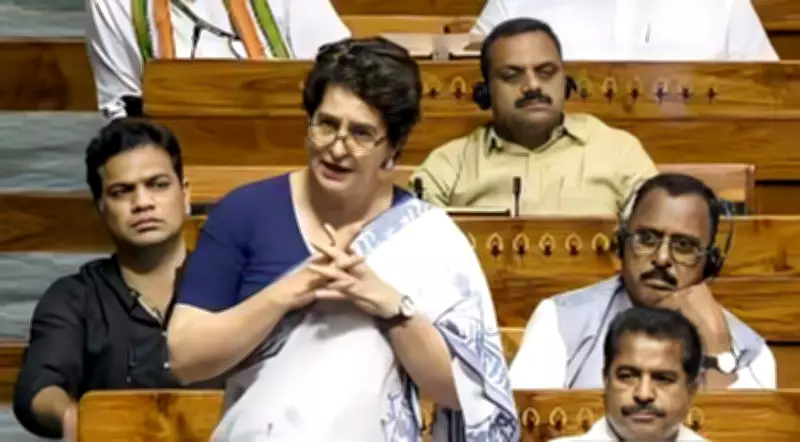
Priyanka Gandhi's Sharp Critique in Lok Sabha on Women's Quota and Delimitation
Congress MP Priyanka Gandhi Vadra delivered a pointed address in the Lok Sabha, intertwining the debates on the Women's Reservation Bill and delimitation with a historical perspective on her party's contributions. Her remarks included a veiled swipe at Union Home Minister Amit Shah, invoking the ancient strategist Chanakya to underscore her critique of the current government's approach.
Historical Legacy of Congress in Women's Empowerment
Vadra emphasized the Congress party's enduring commitment to women's reservation, tracing its origins back to foundational moments in Indian history. She highlighted Motilal Nehru's 1928 report, which laid early groundwork for gender equality, and the 1931 Karachi Congress resolution that explicitly advocated for equal rights. This historical context, she argued, demonstrates Congress's pioneering role in championing women's political representation long before it became a mainstream issue.
Key Milestones and Legislative Efforts
In her speech, Vadra detailed specific milestones where Congress advanced women's reservation:

- Rajiv Gandhi Era: The introduction of 33 per cent reservation for women in panchayats and municipalities during the late 1980s, a landmark move that decentralized power and empowered women at the grassroots level.
- UPA Government (2010): An attempt under Prime Minister Manmohan Singh and Congress President Sonia Gandhi to pass the Women's Reservation Bill, which sought to reserve one-third of seats in the Lok Sabha and state assemblies for women, though it faced political hurdles.
- Rahul Gandhi's Initiative (2018): A letter from Rahul Gandhi to the Prime Minister urging timely implementation of the bill, reaffirming the party's consistent advocacy for gender parity in legislative bodies.
Vadra stressed that these efforts reflect a sustained and principled stance, contrasting it with what she portrayed as delays and political maneuvering by the current administration.
Delimitation Debate and Political Implications
The discussion on delimitation—a process to redraw electoral constituencies based on population changes—added another layer to Vadra's critique. She linked it to the women's quota issue, suggesting that the government's handling of delimitation could impact the effective implementation of reservation policies. By referencing Chanakya, known for his strategic acumen, Vadra implied that the government's tactics might be overly cunning or divisive, rather than focused on genuine empowerment.
This connection underscores broader concerns about how electoral boundaries are redrawn and their potential effects on representation, particularly for marginalized groups like women.
Reaffirmation of Congress's Commitment
Concluding her address, Vadra reaffirmed the Congress party's unwavering support for the Women's Reservation Bill. She called for bipartisan cooperation to ensure its passage, emphasizing that women's political participation is crucial for India's democratic health and social progress. Her speech served as both a historical recap and a call to action, positioning Congress as a steadfast advocate for gender equality in the face of contemporary political challenges.
The Lok Sabha session thus became a platform for revisiting decades of advocacy while highlighting ongoing debates that shape India's legislative future.






