

Raghav Chadha Breaks Silence After AAP Removes Him as Rajya Sabha Deputy Leader
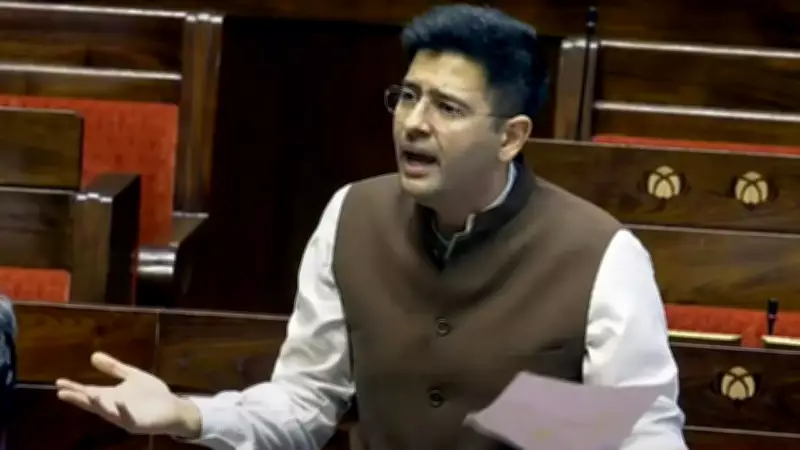
Days after the Aam Aadmi Party removed its Rajya Sabha deputy leader Raghav Chadha, accusing him of shying away from speaking out against Prime Minister Narendra Modi and engaging in what they termed "soft PR," the sidelined MP has launched a forceful counterattack. On Saturday, Chadha broke his silence with a strongly worded video message, quoting a popular dialogue from the film Dhurandhar 2: "ghayal hoon isiliye ghatak hoon" (I am wounded, therefore I am dangerous).
From Confidant to Critic: Chadha's Dramatic Turn
Among the youngest MPs in the country and once seen as a close confidant of Arvind Kejriwal and a key strategist behind the AAP’s 2022 Punjab victory, Raghav Chadha’s journey within the party has taken a dramatic turn. However, over the past year, cracks began to emerge, culminating in his removal on Thursday. The party effectively demoted Chadha and replaced him with Ashok Mittal, but the sharper blow came from the party’s reported communication to the Rajya Sabha secretariat that Chadha should no longer be allotted speaking time from its official quota—a move widely seen as an attempt to sideline him further.
Chadha's Defiant Response
In his video message on X, Chadha dismissed the charges as "baseless and part of a larger, coordinated attempt to discredit him." He made it clear that he had initially chosen restraint but felt compelled to respond as repeated accusations risked being accepted as truth. "All these lies will be unmasked. Kyunki mai ghayal hoon isiliye ghatak hoon," he declared, invoking the film dialogue to signal both injury and intent.

Chadha also released multiple videos under the title "Three Allegations. Zero Truth," directly countering claims made by party leaders. He categorically denied allegations that he did not walk out with the opposition in Parliament, challenging the party to provide evidence. "This is a white lie, and I challenge you to give me one example, one incident, where the opposition walked out and I didn't support them," he said, adding, "There are CCTV cameras everywhere in the parliament. Show me footage and it will become clear."
AAP's Allegations and Internal Criticism
The party leadership has accused Chadha of diluting its political stance in Parliament. Senior leaders alleged that instead of aggressively targeting the Centre and PM Modi, Chadha engaged in "soft PR." They pointed to his refusal to sign the notice seeking the removal of Chief Election Commissioner Gyanesh Kumar and his failure to join Opposition walkouts on key issues in the House.
Punjab Chief Minister Bhagwant Mann, Rajya Sabha leader Sanjay Singh, Delhi leader Atishi, and state unit chief Saurabh Bharadwaj were among those who accused him of deviating from the party line. When asked whether Chadha was "compromised," Mann replied in the affirmative. He criticized the MP for raising issues such as the price of samosas at airports instead of what the party considers core political concerns.
Bharadwaj alleged that Chadha repeatedly failed to toe the party line in Parliament and did not participate in Opposition walkouts. He also accused him of not adequately raising issues concerning Punjab, the state he represents, and of remaining absent during critical moments, including the arrest of AAP convenor Arvind Kejriwal. "All party leaders are soldiers of Kejriwal," Bharadwaj said, stressing the need for discipline and unity.
Chadha's Ideological Stance and Priorities
Perhaps the sharpest ideological divergence came in Chadha’s articulation of his role as a parliamentarian. He rejected the idea that effectiveness in Parliament is measured by disruption. "I did not go to Parliament to create ruckus, scream, break the mic or abuse. I went there to raise problems of people," he said.
He emphasized that his focus has consistently been on substantive public issues, including Punjab’s water crisis, air pollution in Delhi, the condition of government schools, railway passenger problems, GST and income tax burdens, public healthcare, education, menstrual health, unemployment, and inflation. Stressing accountability, he added, "I go to Parliament to create impact not ruckus," noting that Parliament runs on taxpayers’ money and must serve their concerns.

Absence During Critical Moments
A major source of unease within the party has been Chadha’s absence during critical moments. While leaders such as Sanjay Singh and Manish Sisodia faced legal troubles and jail terms, Chadha’s absence from key press conferences and protest sites drew scrutiny. He was abroad for medical reasons when Kejriwal was arrested in the excise policy case in March 2024 and remained away during his nearly six-month incarceration, meeting him only days after his release on September 13, 2024.
More recently, Chadha maintained silence even after Kejriwal, Sisodia, and other AAP leaders were discharged by a Delhi court in the same case, and he also skipped Kejriwal’s press conference and a rally at Jantar Mantar following the relief.
Political Reactions and Broader Implications
The controversy has drawn reactions from political opponents as well. The Bharatiya Janata Party came out in support of Chadha, using the episode to criticize AAP’s internal functioning. Delhi BJP president Virendra Sachdeva said that a senior MP being forced to use social media to voice concerns indicated a breakdown of dialogue within the party. "When a senior MP is forced to use social media to express his views within his own party, it reflects a deeply troubling internal condition," he said.
The AAP currently has 10 members in the Rajya Sabha, including seven from Punjab and three from Delhi, making the internal rift all the more significant for the party’s parliamentary strategy. Chadha now becomes the second Rajya Sabha MP after Swati Maliwal to fall out with the party leadership, pointing to a broader pattern of internal tensions.
As the slugfest continues, Chadha’s cryptic earlier post on X, sharing video highlights of his speeches in the Upper House along with a "nazar" (evil eye) amulet emoji, without offering any direct comment, now seems a prelude to this open confrontation. The cracks, party insiders suggest, have been widening for nearly two years rather than emerging suddenly, setting the stage for further political drama.





