

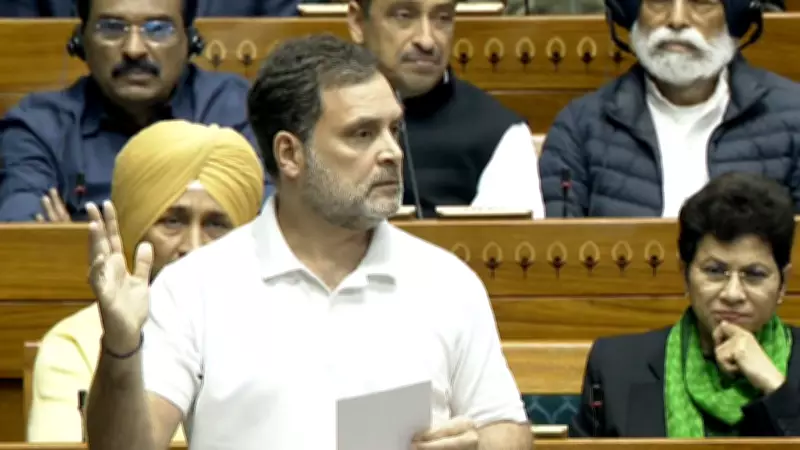
Rahul Gandhi Accuses Government of Ceding Data Control and Tariff Leverage in US Agreement
In a sharp critique delivered in the Lok Sabha, Leader of the Opposition Rahul Gandhi asserted that India has buckled under pressure in recent trade negotiations with the United States, resulting in a significant loss of control over digital trade rules and tariff policies. He warned that these concessions could undermine the nation's economic sovereignty and strategic interests.
Global Instability and the Era of War
Gandhi began his address by referencing the government's Economic Survey, which he said indicates a global shift from stability to instability. He contrasted this with earlier statements by Prime Minister Narendra Modi and National Security Advisor Ajit Doval, who had declared the era of war over. Citing ongoing conflicts such as those in Ukraine and Gaza, rising tensions in the Middle East, and operations like Sindoor, Gandhi argued that the world is, in fact, entering a period of heightened conflict. He noted that this transition is marked by challenges to US dollar dominance and the emergence of multiple power centers.
Artificial Intelligence: The Central Battleground
At the heart of this global contest, Gandhi emphasized, is artificial intelligence (AI). He issued a stark warning about AI's profound consequences, drawing an analogy to highlight the critical role of data. Discussing AI without data is like talking about an internal combustion engine without petrol, he stated. The petrol for AI is data. If you have AI and not data, you have nothing. He cautioned that information technology companies could face severe challenges if data sovereignty is compromised.

India's Core Strengths Under Threat
Gandhi identified three fundamental strengths that India must safeguard in these turbulent times:
- People and Data: He described India's 1.4 billion population as its greatest asset, with the data they generate being the country's most valuable resource. In a contest between the US and China, the single most valuable asset is Indian data, he remarked, noting that China also possesses data from a similarly large population. Gandhi urged India to recognize data as a strategic strength and negotiate globally as an equal partner.
- Food Security: Driven by farmers and laborers, India's food supply chain is essential for national stability.
- Energy Systems: Secure energy sources are vital for sustaining data infrastructure and overall economic resilience.
Allegations of Trade Concessions and Tariff Imbalances
Turning to specific policy criticisms, Gandhi alleged that India has relinquished control over its digital trade regulations in dealings with the US. He claimed that tariffs have surged from an average of 3 percent to 18 percent, a six-fold increase, while US tariffs have dropped from 16 percent to zero. This disparity, he argued, could lead to a projected rise in US imports from $46 billion to $146 billion, potentially harming domestic industries.
Illustrating the impact, Gandhi shared an anecdote from a visit to a textile factory in Gurugram, where workers expressed despair, stating they were finished because Bangladesh enjoys zero tariffs while India faces an 18 percent duty. This, he said, highlights the adverse effects on local employment and manufacturing.
Energy Security and External Oversight Concerns
On energy security, Gandhi raised alarms about alleged provisions in the trade deal that would allow the United States to decide and monitor India's oil purchases, including from countries like Russia and Iran. He warned that such oversight could lead to the weaponization of energy and finance against India, jeopardizing its autonomy. Energy security is critical for sustaining data, he emphasized, underscoring the interconnectedness of these strategic areas.

In conclusion, Rahul Gandhi's speech in Parliament painted a picture of a nation at risk of compromising its core strengths through unfavorable trade agreements. His warnings about data control, tariff imbalances, and energy oversight call for a reevaluation of India's negotiation strategies in an increasingly unstable global landscape.





