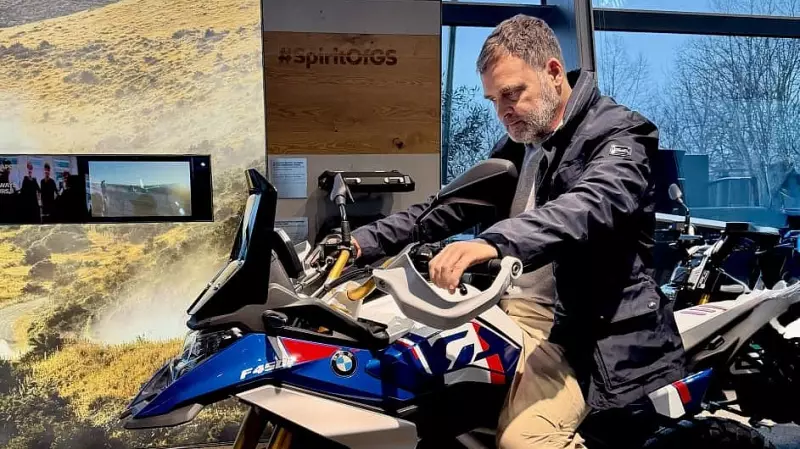
Senior Congress leader Rahul Gandhi, currently on a visit to Germany, made a significant stop at the iconic BMW Welt (BMW World) in Munich on Tuesday. During his tour of the premium automobile manufacturer's facility, Gandhi emphasized a crucial message for India's economic future: the nation must significantly ramp up its production and manufacturing capabilities to generate employment and ensure prosperity for its youth.
A Firsthand Look at German Engineering and Industrial Might
The visit to the BMW Welt, a combined exhibition, delivery, and adventure museum, provided Gandhi with an up-close view of advanced automotive manufacturing and innovation. In a post on social media platform X (formerly Twitter), the Congress MP shared his impressions. He stated that witnessing the sophisticated operations at BMW reinforced his belief that India needs to produce more. "The way to prosperity for our youth is to produce more in India," Gandhi wrote, sharing pictures from his tour where he examined various BMW models and interacted with officials.
Gandhi's observations in Germany come at a time when his party has been consistently critiquing the Narendra Modi-led government's economic policies. The Congress has repeatedly raised concerns about unemployment and what it terms as inadequate growth in the manufacturing sector. The Opposition leader's German tour is seen as part of his broader engagement to study different economic models and industrial policies.

Connecting the German Visit to India's Domestic Challenges
Rahul Gandhi's advocacy for boosting domestic production is directly tied to his recent political campaign. This message aligns closely with the core themes of his recently concluded 'Bharat Jodo Nyay Yatra,' which traversed over 6,700 kilometers from Manipur to Mumbai. Throughout that journey, unemployment and the need for equitable economic development were central pillars of his discourse.
In his social media post, Gandhi drew a direct contrast between the industrial environment he witnessed in Germany and the situation in India. "The contrast between the industrial model I saw in Germany and what we have in India today is stark," he remarked. He pointed out that while one model creates jobs and prosperity, the other, in his view, results in high unemployment and mounting public debt. This critique is squarely aimed at the current Indian government's policy framework.
The Political and Economic Context of the Statement
The Congress leader's comments are not made in a vacuum. They feed into a larger political narrative ahead of crucial elections. The Indian opposition has consistently highlighted data pointing to jobless growth and a struggling rural economy. By using the backdrop of a globally renowned manufacturing hub like BMW, Gandhi seeks to visually and substantively bolster his argument for a policy shift towards large-scale job creation through industrial production.
His visit also underscores the importance of foreign engagement for political leaders to gain firsthand knowledge of global best practices. Analysts suggest that such tours allow opposition figures to build a repertoire of policy alternatives and present themselves as leaders with a wider, international perspective on governance and economic management.
While the BJP-led government has championed initiatives like 'Make in India' and reported increases in Foreign Direct Investment (FDI), the opposition contends that these measures have not translated into sufficient mass employment. Gandhi's statement from Munich is a direct contribution to this ongoing debate, using a powerful symbol of German industrial success to make his case for a different path for India's economy.