

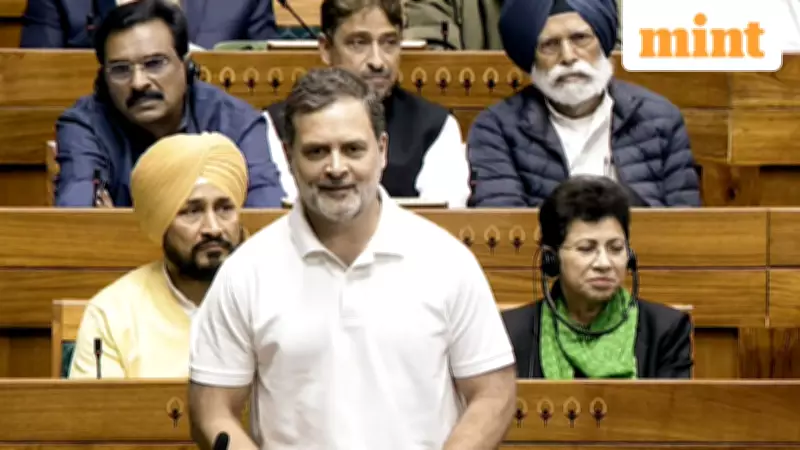
Rahul Gandhi Positions Indian Data as Critical Leverage in US Relations
In a significant parliamentary address on Wednesday, Leader of the Opposition Rahul Gandhi articulated a bold vision for India's foreign policy, declaring that Indian data represents the nation's most crucial strategic asset in its relationship with the United States. Speaking in the Lok Sabha for over forty-five minutes during discussions on Budget 2026, the Congress leader framed data as the central pillar of India's geopolitical strength.
Tariff Disparities and the Call for Equal Negotiations
Gandhi highlighted what he described as a significant imbalance in trade relations, claiming that India's tariffs have escalated from 3 percent to 18 percent, while American tariffs have been reduced from 16 percent to zero percent. He argued that this disparity underscores the need for India to negotiate from a position of strength, with data as its primary bargaining chip.
"While negotiating with President Trump, the most important thing in this equation is Indian data," Gandhi stated emphatically. "You want to protect the dollar, we are your friends. And we appreciate you and help you protect the dollar. The biggest asset for that is the Indian people."

He further asserted that any future negotiations must be conducted on equal terms, directly addressing the US leadership: "If you want access to this data, you have to talk to us like equals. Not your servants."
Data as India's Strategic Advantage in Global Instability
The Rae Bareli MP elaborated that in an increasingly volatile global landscape, Indian data could play a decisive role in the geopolitical contest between the United States and China. He challenged the notion that population is a burden, instead reframing it as a national advantage in the 21st century.
"What we bring to the table is our people—their wisdom, what they do, their likes and dislikes, their imagination and their fear. In the 21st century, this has suddenly got value," Gandhi explained. "Population is not a weight. It is the biggest asset you can have. But it is only a strength if you recognize that data."
He pointed to the Economic Survey, noting two profound developments: intensifying geopolitical conflict and the weaponization of energy and finance. According to Gandhi, the world is transitioning from stability to instability, with the United States facing challenges from China, Russia, and other forces.
Criticism of Government's Approach and Broader Geopolitical Context
Gandhi launched a sharp critique against the central government, accusing it of having fully surrendered to American interests. "The point is that I don't believe that an Indian PM, including Mr. Modi, would sign the deal unless there was a chokehold on him," he declared in the House.
He also addressed broader security concerns, disputing earlier statements by Prime Minister Modi and National Security Adviser Ajit Doval that "the era of war is over." Gandhi countered that the world is entering a period marked by open conflict, citing wars in Ukraine and Gaza, tensions in the Middle East, threats around Iran, and India's own Operation Sindoor as evidence of growing instability.
Congress Walkout and Parliamentary Dynamics
Earlier on Wednesday, the speech followed a dramatic walkout by Congress party leaders from the Lok Sabha. They protested the refusal of Chair P C Mohan to allow them to raise certain questions during the Question Hour, highlighting the tense parliamentary atmosphere surrounding these discussions.
Gandhi concluded by reiterating the INDIA bloc's stance: "The main thing I am saying is that the INDIA bloc government will go and say data is our biggest strength. We will go there as equals. And we will not be made equal to Pakistan." This statement underscores his vision of data sovereignty as fundamental to India's position on the global stage.






