

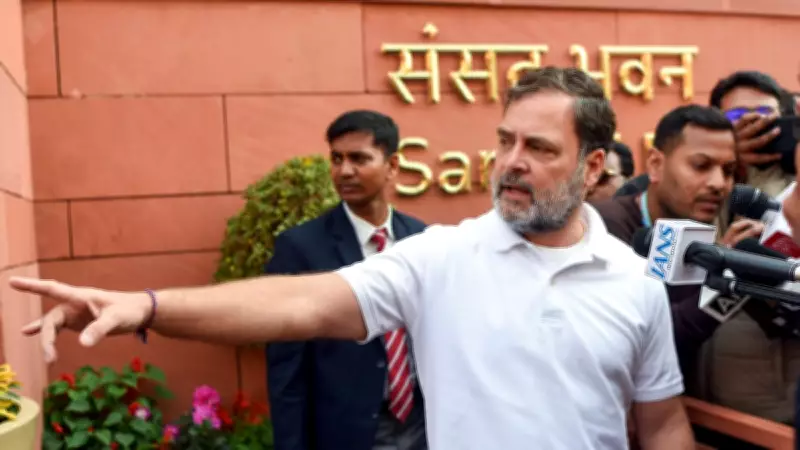
Rahul Gandhi Intensifies Pressure on Government Over India-US Trade Agreement
Congress leader Rahul Gandhi has significantly ramped up his political offensive against the central government, focusing sharply on the ongoing negotiations for an India-United States trade deal. In a strongly worded statement, Gandhi asserted that the nation's farmers deserve absolute clarity and transparency regarding the potential implications of this pivotal international agreement.
Demand for Farmer-Focused Transparency
Gandhi emphasized that the agricultural community, which forms the backbone of India's economy, must not be left in the dark. He argued that any trade pact with a major economic power like the United States could have profound and lasting effects on domestic markets, crop prices, and the livelihoods of millions. The lack of detailed public discourse on the deal's specifics, according to Gandhi, is a disservice to those who will be most directly impacted.
Five Critical Questions Posed to the Government
To substantiate his demand for accountability, the Congress leader raised five pointed questions directed at the ruling administration:

- Impact on Minimum Support Prices (MSP): How will the trade deal affect the government's ability to maintain and increase Minimum Support Prices for key crops, a crucial safety net for farmers?
- Market Access and Competition: What specific measures are in place to protect Indian farmers from being overwhelmed by subsidized agricultural imports from the US?
- Intellectual Property Rights on Seeds: Does the agreement contain clauses that could restrict farmers' traditional rights to save, use, and exchange seeds, potentially increasing their dependence on multinational corporations?
- Long-term Food Security: How does the government ensure that the deal strengthens, rather than compromises, India's long-term food security and self-sufficiency goals?
- Consultation Process: What meaningful consultation has been conducted with farmer unions, state governments, and agricultural experts before finalizing the negotiation stance?
Political Context and Escalating Tensions
This move marks a clear escalation in Rahul Gandhi's political strategy, positioning the Congress party as the primary defender of agrarian interests. The questions are designed to put the government on the defensive, forcing it to address concerns that have been simmering within the farming community for some time. The issue taps into broader anxieties about globalization and trade liberalization's effects on small-scale agriculture.
The timing of this critique is also politically significant, coming amidst ongoing efforts by the government to bolster economic ties and increase exports. Gandhi's intervention ensures that the farmer's perspective remains central to the national conversation on trade.
Government's Response and the Road Ahead
While the government has previously stated that all trade agreements are negotiated with national interests at the forefront, it has yet to issue a detailed, point-by-point rebuttal to Gandhi's specific queries. The opposition's demand is likely to intensify parliamentary debates and public scrutiny as negotiations with the US progress. The coming weeks will reveal whether the administration provides the clarity demanded or if this becomes a sustained point of political contention, especially in agriculturally dominant states.
Ultimately, Rahul Gandhi's forceful stance underscores a critical political battle over economic policy, where the welfare of farmers is being positioned as a non-negotiable priority in India's engagement with the global economy.






