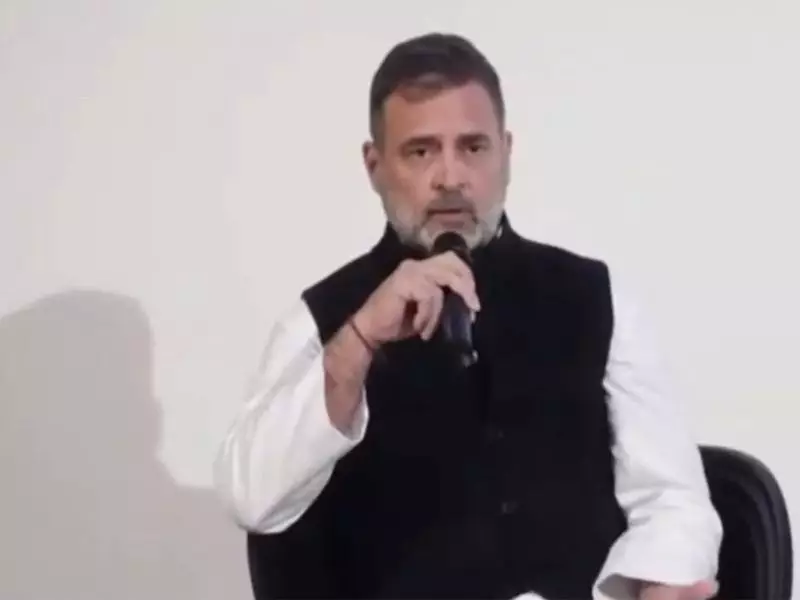
Congress leader Rahul Gandhi has sparked a fresh political controversy by raising serious questions about the integrity of India's electoral machinery during a public address in Germany. The former Congress president made these remarks while participating in a lecture series at a prestigious German university, drawing immediate and sharp criticism from the ruling Bharatiya Janata Party back home.
Key Allegations on Democratic Institutions
During his interaction, Rahul Gandhi presented a critical analysis of the current state of Indian democracy. He asserted that there is a significant problem with the electoral machinery in India, suggesting that the instruments of democracy are not functioning as intended. The leader of the opposition did not limit his critique to the electoral process alone.
He expanded his argument to include other pillars of democracy, claiming that India's press, judiciary, and election commission are under pressure. According to his assessment, these institutions are facing challenges that compromise their independence and ability to function without external influence.

Context and Venue of the Remarks
The comments were delivered at the 'Falling Walls' lecture series, an event hosted at the Technical University of Berlin. This platform is known for hosting thought leaders who discuss breakthrough ideas. Gandhi's participation placed his views on an international stage, ensuring they reached a global audience beyond India's borders.
In his lecture, Gandhi framed his critique within a broader narrative. He argued that the idea of India as a union of states is under attack. He expressed concern that a narrow, centralized vision is being imposed, which he believes contradicts the nation's foundational pluralistic ethos.
BJP's Swift and Forceful Rebuttal
The reaction from the ruling BJP was swift and severe. Party leaders accused Rahul Gandhi of insulting India on foreign soil and tarnishing the country's global image. They characterized his statements as an attempt to undermine international confidence in India's robust democratic processes, especially as the nation prepares for upcoming general elections.
BJP spokespersons launched a counter-offensive, defending the independence of India's institutions. They highlighted the scale and success of recent elections, including the peaceful conduct of polls in Jammu and Kashmir, as evidence of the system's health. The ruling party's response framed Gandhi's criticism as politically motivated sour grapes from an opposition struggling to find electoral success.
Implications and Ongoing Political Battle
This incident is not an isolated one but part of a recurring pattern where Indian political figures take domestic debates to international forums. The episode has reignited the debate about the propriety of criticizing national institutions abroad. It also sets the stage for a heated political discourse as India moves closer to its next major electoral test.
The controversy underscores the deep ideological divide between the ruling party and the principal opposition party on the very nature of Indian democracy. While the Congress and Rahul Gandhi position themselves as defenders of institutional integrity, the BJP portrays them as detractors who cannot accept the popular mandate. This clash of narratives is likely to intensify in the coming months, with both sides using it to mobilize their respective voter bases.