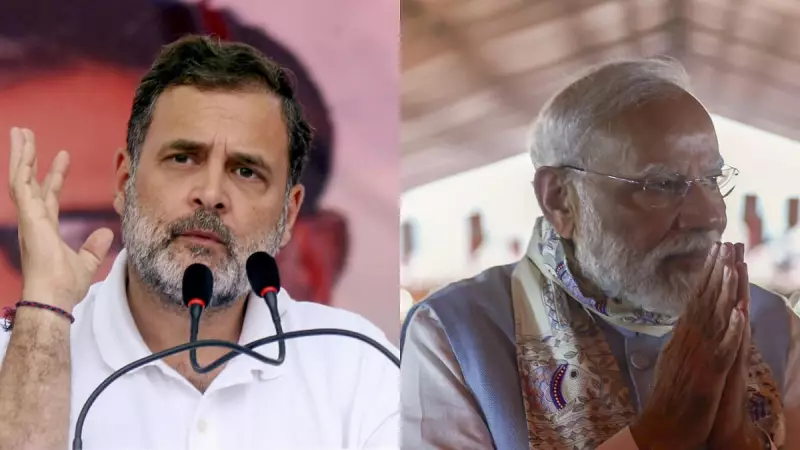
Congress leader Rahul Gandhi launched a sharp political attack on the Indian government on Tuesday, January 7, 2026, leveraging a recent statement made by former US President Donald Trump. The controversy stems from Trump's claim that Prime Minister Narendra Modi is "not that happy with me" due to tariffs imposed by Washington on New Delhi for its purchases of Russian oil.
The Provocation: Trump's Tariff Claim
On Tuesday, former US President Donald Trump made a statement that quickly ignited a political firestorm in India. He asserted that Prime Minister Narendra Modi's administration was displeased with him because of the economic penalties levied by the United States. These tariffs were specifically linked to India's continued procurement of crude oil from Russia, a point of contention in international diplomacy following geopolitical conflicts.
Trump's candid remark, suggesting a strain in the personal equation between the two leaders over trade policy, provided immediate ammunition for the opposition. The statement was picked up by news agency PTI and widely circulated, setting the stage for a political rebuttal.

Rahul Gandhi's "फ़र्क समझो" Retort
Seizing the moment, Rahul Gandhi, a key figure in the Indian National Congress, took to social media platform X (formerly Twitter) to deliver a pointed critique. In a post that included a screenshot of a news headline about Trump's comments, Gandhi wrote a succinct but loaded caption in Hindi: "फ़र्क समझो, सर जी!" which translates to "Understand the difference, Sir!".
This phrase is widely interpreted as a dig at the ruling Bharatiya Janata Party (BJP) government's foreign policy and its much-publicized close ties with the Trump administration during his previous term. Gandhi's implication suggests a gap between the government's projected strength in international relations and the reality of being called out by a key ally on a sensitive economic issue.
Broader Implications for Diplomacy and Domestic Politics
The exchange highlights the ongoing complexities in India-US relations, particularly concerning India's independent energy policy and its historical defense and trade partnership with Russia. The imposition of US tariffs is a tangible economic consequence that contrasts with the strategic camaraderie often displayed between the two nations' leaders.
Domestically, the incident has been swiftly folded into the political narrative. The opposition, led by figures like Rahul Gandhi, aims to portray the government as facing diplomatic pressure and criticism from its closest partners. The BJP, on the other hand, has historically framed its foreign policy as strong and pragmatic, safeguarding national interests even amidst global pressures.
This public airing of a purported disagreement, amplified by a figure like Trump and leveraged by the opposition, puts the government in a position where it may need to clarify its stance. The development underscores how international trade disputes can rapidly transform into potent tools for domestic political criticism, especially in the lead-up to or in the wake of national elections.
The ball is now in the court of the Indian government to formally respond to Trump's characterization and address the political critique from the Congress party. The episode serves as a reminder of the intricate interplay between global economic policies and local political fortunes.