

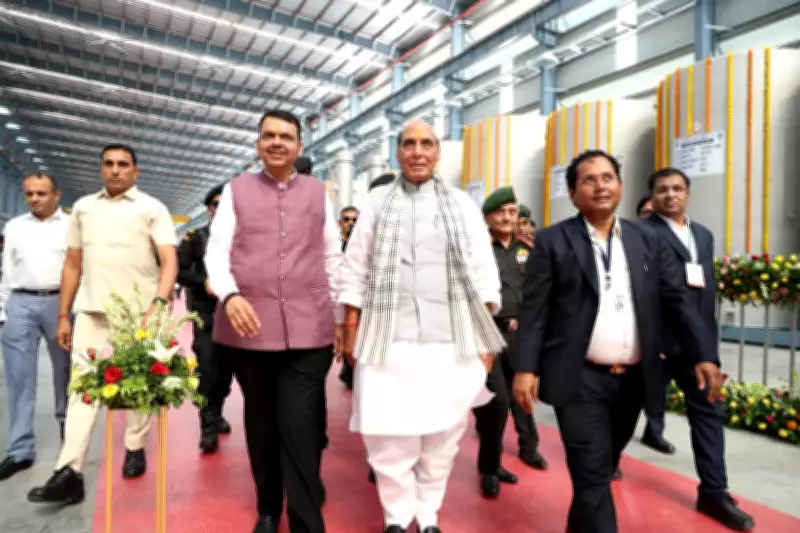
Defence Minister Rajnath Singh on Saturday asserted that the outcome of future wars will no longer be determined by the sheer number of soldiers a country possesses, but by its prowess in automation and advanced weapon systems. Speaking in Shirdi, Ahilyanagar district, Singh underscored the urgent need for India to bolster its technological capabilities to maintain a strategic edge.
The minister made these remarks during the inauguration of a state-of-the-art defence manufacturing complex by the NIBE Group, a private sector firm. The new facility is set to manufacture advanced artillery systems, missile and space technologies, rocket systems, and autonomous defense platforms. Chief Minister Devendra Fadnavis was also present at the event.
Automation and Technology as Key Factors
“In future wars, the decisive factor will not be troop strength, but how advanced a country is in munitions and automation,” Singh said. “We are already seeing this play out in the Russia-Ukraine conflict and the ongoing tensions in West Asia. India, too, has demonstrated its growing technical capabilities in recent operations.”

Emphasising that modern warfare is increasingly driven by high-end technology and unmanned systems, the defence minister called on the private sector to lead the charge. He said the Union government is prioritising critical technologies—particularly in the drone sector—under the ‘Make in India’ initiative to ensure the indigenisation of the armed forces.
India’s Transition from Importer to Exporter
Singh highlighted India’s dramatic transition from a leading arms importer to an emerging export powerhouse. “Our country was once viewed primarily as an importer of weapons. Today, no power can stop India from becoming the largest exporter in the next 25 to 30 years,” he said, adding that the government is committed to making India a frontrunner in automated combat systems.
The minister described the private sector as central to the vision of a self-reliant India (Aatmanirbhar Bharat). He noted that private industry brings essential “risk-taking ability, efficiency, innovation, and research” to the defense landscape.
Private Sector Contribution Rising
“The contribution of private players to defence production, which was once negligible, has risen to 25–30%,” Singh said. “Our goal is to increase this share to 50% in the coming years.”
He said the new Shirdi facility represents a major shift in the domestic ecosystem, where private companies are moving beyond component manufacturing to become full-fledged innovators of state-of-the-art weaponry.
“Nations that manufacture their own weapons shape their own destiny,” Singh said. “The fact that foreign companies are now eager to partner with India for technology transfer proves our strengthening identity in the global defence sector. A self-reliant India is a secure and capable India.”






