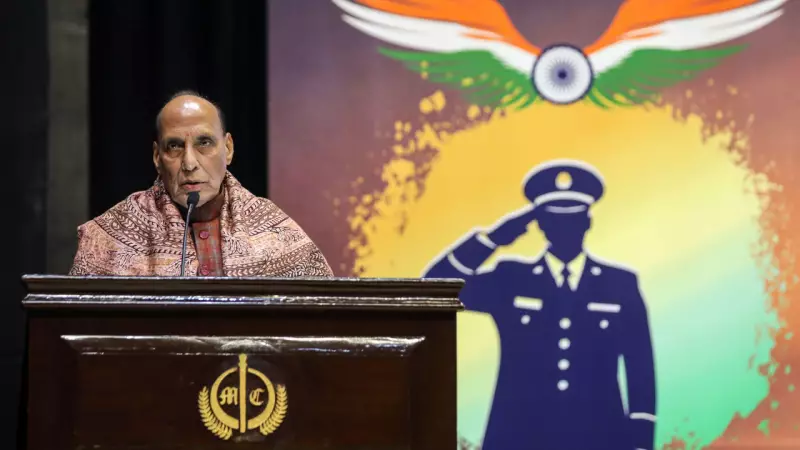
Defence Minister Rajnath Singh made a strong appeal on Wednesday. He urged the nation to recognise and honour the sacrifices of Indian soldiers during Operation Pawan in Sri Lanka. This military engagement happened nearly forty years ago.
Criticism of Past Governments
Speaking at an event marking the 10th Armed Forces Veterans' Day, Singh expressed clear regret. He stated that the contributions of the Indian Peace Keeping Force (IPKF) troops were not respected by governments of that era.
"The decision taken by the then government to send Indian troops to Sri Lanka is open to debate," Rajnath Singh said. "But the neglect of IPKF troops who took part in the operation cannot be justified in any sense. Their sacrifice and struggle during that period was not respected."

The Heavy Toll of Operation Pawan
Historical records show India lost approximately 1,200 soldiers. These casualties occurred during the IPKF's deployment in Sri Lanka between July 1987 and March 1990. The operation aimed to bring peace to Tamil-dominated areas ravaged by prolonged violence and civil strife.
"Many soldiers died in the line of duty," the Defence Minister noted. "Their courage and sacrifice should have been an inspiration for our future generations, but unfortunately it did not happen."
Current Government's Stance and Actions
Rajnath Singh highlighted the different approach of the current administration. He asserted that the Modi government is actively acknowledging the peacekeepers' role with an open mind.
"We are in the process of recognising their contribution at every level," he declared. Singh recalled that Prime Minister Narendra Modi paid homage to Indian soldiers at the IPKF memorial during his 2015 visit to Sri Lanka.
The minister provided a concrete example of this recognition. "Now, we are also recognising the contributions of the IPKF soldiers at the National War Memorial in New Delhi and giving them the respect they deserve."
Historical Context of the IPKF Mission
The deployment followed the India-Sri Lanka peace accord signed on July 29, 1987. Despite the initial goal, lasting peace proved elusive in the region. The IPKF was eventually withdrawn.
It is noteworthy that the Rajiv Gandhi government made the decision to send the force. However, the troops were pulled out during the tenure of Prime Minister VP Singh.
Honouring Veterans and Welfare Initiatives
During his address, Rajnath Singh praised veterans as the living pillars of national consciousness. He described them as symbols of collective courage and an inspiration for the youth.
The Defence Minister urged veterans to guide young soldiers, including Agniveers, by sharing their valuable experiences. He reiterated his government's firm commitment to veterans' welfare.
Singh enumerated key steps taken in this direction:
- Fulfilling the long-pending demand for One Rank One Pension (OROP).
- Strengthening the Ex-Servicemen Contributory Health Scheme (ECHS).
The Scale of Veteran Welfare
A senior official pointed out the magnitude of this responsibility. The secretary for ex-servicemen welfare stated that around 60,000 soldiers retire every year. This results in a veteran population of approximately 3.5 million people.
Caring for such a large community is a significant national duty. The government emphasizes its ongoing efforts to meet this obligation and honour those who served.