India's Republic Day Parade Spotlights Military Prowess After Counterterror Success
Following India's significant counterterrorism achievement through Operation Sindoor in 2025, this year's Republic Day parade in New Delhi placed a strong emphasis on the nation's military capabilities. The grand spectacle along Kartavya Path, previously known as Rajpath, featured an impressive array of weapons platforms and advanced defence systems, showcasing the armed forces' combat readiness and technological advancements.
Aerial Displays and Ground Formations Demonstrate Strategic Power
The visual spectacle extended to the skies above Raisina Hills, where Air Force formations performed flypasts in the presence of European chief guests, international delegations, and thousands of spectators. The aerial demonstration included the dramatic unfurling of the Operation Sindoor flag midair, creating a powerful visual statement that reinforced themes of deterrence and military preparedness.
For the first time on Kartavya Path, the 'Battle Array' formation made its debut, signaling a strategic shift from traditional ceremonial displays to combat-ready battlefield configurations. This evolution reflects the Indian Army's ongoing transition toward modern, multi-domain warfare capabilities.

Operation Sindoor Display Highlights Coordinated Military Action
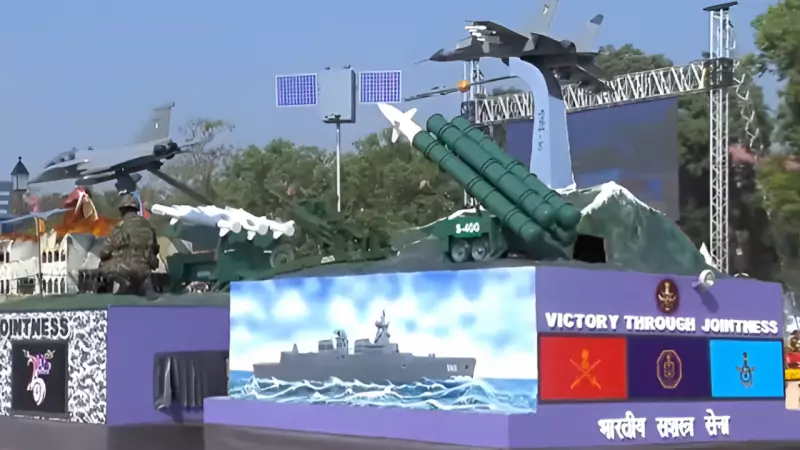
A glass-encased Integrated Operational Centre depicting Operation Sindoor rolled down Kartavya Path during the 77th Republic Day celebrations. This detailed display illustrated how the operation was executed and demonstrated the seamless coordination between India's Army, Navy, and Air Force branches.
The tri-services tableaux delivered a clear strategic message to Pakistan by showcasing the formidable striking power of the BrahMos missile alongside the robust S-400 air defence system. These elements form crucial components of India's comprehensive defence strategy known as the "Sudarshan Chakra," which proved effective during heightened military tensions with the nuclear-armed neighbor in May.
Operation Sindoor resulted in the neutralization of more than 100 terrorists and enemy combatants, with several key enemy assets destroyed. The military action brought adversary operations to a complete standstill within just 88 hours.
Background and Strategic Context of Military Operations
The military action was initiated in response to the devastating April 2025 terrorist attack in Pahalgam, which claimed 26 lives. In retaliation, Indian forces conducted precision strikes on terrorist bases within Pakistan, targeting critical infrastructure and eliminating multiple terrorist operatives.
The Integrated Operational Centre display emphasized that Operation Sindoor was guided by both national and military leadership, with exceptional coordination between the Army, Navy, and Air Force. Civilian support and seamless inter-service cooperation were highlighted as crucial factors contributing to the operation's success.
Advanced Defence Systems and Indigenous Technology Showcased
The parade's theme of "Virasat, Vividhta aur Vikas" (Heritage, Diversity, and Development) was prominently featured throughout the displays. While the BrahMos missile demonstrated its capacity for decisive strikes against enemy targets, air defence systems including Akash and S-400 provided comprehensive protection for civilian areas under the "Sudarshan Chakra" concept.
As part of the Combat Support Elements segment, the parade featured Divyastra and Shaktibaan systems mounted on High Mobility Vehicles (HMV 6x6). These platforms represent the Indian Army's significant push toward indigenization and modernization of military equipment.
Unmanned Warfare Capabilities and Precision Targeting Systems
India's new-generation unmanned warfare capabilities were prominently displayed through Shaktibaan and Divyastra systems. These advanced platforms are specifically designed for surveillance and targeting operations, representing a major advancement toward technology-driven precision warfare.

Both Shaktibaan and Divyastra systems are equipped with swarm drones, tethered drone systems, and the indigenously developed hybrid UAV ZOLT, which serves critical functions in directing artillery fire. Their sophisticated targeting capabilities are supported by various loitering munitions including Harop, Mini Harpy, Peacekeeper, ATS (Extended Range), ATS (Medium Range), and Sky Striker systems.
According to defence ministry officials, these advanced systems enable the armed forces to deploy swarm drones, long-range strike drones, and loitering munitions for highly effective battlefield operations, significantly enhancing India's defensive and offensive capabilities.