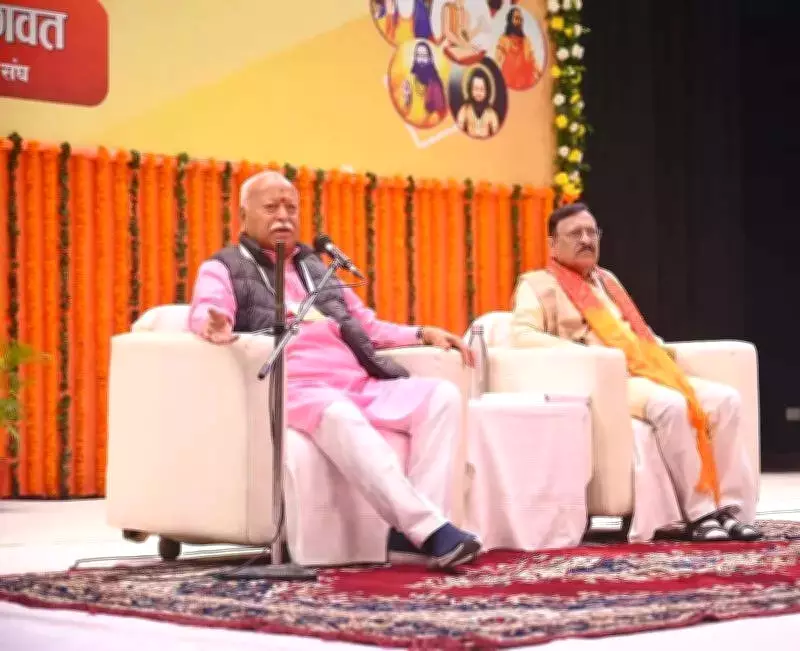
RSS Chief Mohan Bhagwat Elaborates on Organization's Philosophical Foundations in Gorakhpur Speech
In a significant address during the Rashtriya Swayamsevak Sangh's centenary year celebrations, chief Mohan Bhagwat articulated that the RSS's worldview is entirely rooted in Indian philosophical traditions. Speaking at the Baba Gambhirnath auditorium in Taramandal, Gorakhpur, Bhagwat clarified that the organization's perspective is neither a reaction to specific circumstances nor driven by competition with other entities.
India as a Dharma-Pran Nation and RSS's Core Mission
Bhagwat underscored that India is fundamentally a "dharma-pran" nation, where ethical conduct and moral values form the bedrock of social existence, shaped by inter-generational wisdom. He explained that the RSS aims to organize society based on principles of tolerance, coordination, and selflessness, fostering a cohesive community structure.
Addressing a prominent citizens' meet organized by the RSS Goraksh province, Bhagwat noted that global expectations from the Sangh have heightened amid worldwide conflicts and uncertainties. "There is no existing model elsewhere that can ensure lasting peace and societal happiness. The world is increasingly looking toward India with hope," he asserted, emphasizing that Indian knowledge systems provide viable solutions to modern challenges.

Autonomy and Purpose of the RSS
Bhagwat maintained that the RSS is an autonomous, independent, and self-reliant organization dedicated solely to national service, rather than pursuits of power, influence, or popularity. "The sangh has not come to destroy but to fulfil," he stated, invoking a Biblical phrase to highlight that the organization does not operate in opposition to any group. He added that if society becomes fully organized and capable, the RSS's role would naturally diminish.
Historical Context and Ideological Streams
Tracing ideological currents from India's freedom struggle, Bhagwat referenced four broad streams:
- The revolutionary path, associated with leaders like Subhas Chandra Bose, which sought to overthrow British rule through armed struggle.
- The movement emphasizing political awakening among the masses.
- The focus on social reform and modern scientific advancement, led by figures such as Raja Ram Mohan Roy, who aimed to align Indian society with contemporary knowledge.
- The call for a return to civilizational roots, articulated by spiritual leaders including Swami Vivekananda and Swami Dayananda Saraswati.
Bhagwat explained that RSS founder KB Hedgewar engaged with these streams and concluded that while political independence was inevitable, addressing social weaknesses was crucial to prevent its loss. This insight led to the establishment of the RSS on Vijayadashami in 1925, which later developed a methodology centered on discipline, character-building, and social organization.
Defining Hindu Society and Centenary Initiatives
Clarifying the term "Hindu society," Bhagwat described it as a cultural and civilizational identity rather than a narrow religious label. "It is a civilizational description of people who believe in harmony, coexistence, and respect for diverse paths toward a common goal," he said, noting that "Hindu" functions as an adjective describing a holistic way of life.
As part of its centenary initiatives, Bhagwat highlighted the "Panch Parivartan" agenda, which includes:
- Social harmony
- Civic responsibility
- Environmental awareness
- Family awakening
- Self-realization
This agenda aims to build a strong, unified society by addressing key areas of personal and collective development, reflecting the RSS's ongoing commitment to national rejuvenation through traditional values and modern relevance.