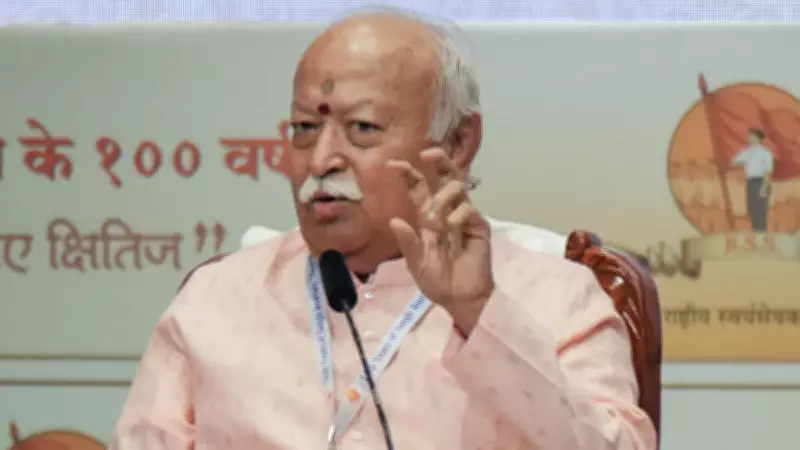
RSS chief Mohan Bhagwat on Sunday stressed that population control policies and the Uniform Civil Code (UCC) require public cooperation and cannot be implemented solely through legislation. Speaking at a Hindu convention in Nagpur, Bhagwat said that laws alone are insufficient to bring about social change and that the participation of the people is essential.
Public Cooperation Key to Reform
Bhagwat argued that while the government can enact laws, their effectiveness depends on the willingness of the public to adopt them. He cited the example of family planning, noting that despite decades of government programs, population growth remains a challenge because it requires a change in mindset. "Population control is not just a matter of law; it is about creating awareness and ensuring that people voluntarily adopt small family norms," he said.
Uniform Civil Code and Social Harmony
On the Uniform Civil Code, Bhagwat said that it is necessary for national integration and gender justice, but it must be implemented with the consent of all communities. He emphasized that the UCC should not be seen as a tool to target any particular religion but as a means to ensure equality before the law. "We need a dialogue with all stakeholders to build consensus. The UCC cannot be imposed; it must be accepted by society," he added.

Hindu Convention Address
The RSS chief was addressing a gathering of Hindu leaders and activists, where he also spoke about the importance of preserving Hindu culture and values. He called for unity among Hindus and urged them to work for the welfare of the nation. Bhagwat’s remarks come at a time when the ruling Bharatiya Janata Party (BJP) has been pushing for a Uniform Civil Code, with some states like Uttarakhand already implementing it. The issue has sparked debate across the country, with opposition parties accusing the government of targeting minorities.
Bhagwat’s emphasis on public cooperation reflects the RSS’s long-standing position that social reforms must be driven by grassroots participation rather than top-down legislation. He also highlighted the role of voluntary organizations in spreading awareness about population control and legal reforms.
In conclusion, Bhagwat reiterated that both population control and the Uniform Civil Code are essential for India’s progress, but their success hinges on the active support of the people. He called on all sections of society to engage in constructive dialogue and work together for a harmonious and prosperous nation.